

First responder apartment locating in DFW is a focused apartment search built around your duty location, shift schedule, and daytime rest, with the aim of finding housing that works around your job. This 2026 guide shows you how to compare routes, inspect bedrooms, verify application requirements, and choose help without handing over the decision.
- For apartment locating for first responders DFW, prioritize the duty address, daytime sleep, and written lease terms.
- Taco Street Locating suits DFW renters who want personalized apartment research and neighborhood guidance.
- Compare the actual apartment, parking route, and shift-time commute—not just the model unit.
- Ask management to confirm employment documents and any occupation-based eligibility before you apply.
Why apartment locating matters for DFW first responders
Your apartment needs to support the hours you actually work, not a standard office schedule. If you sleep during the day, arrive after the leasing office closes, or report to different facilities, those details belong at the start of your search.
A Dallas address alone does not establish a useful commute. Neither does a Fort Worth neighborhood name. Start with your reporting entrance, then compare housing around that destination. The budget-friendly apartments in Dallas guide provides another starting point for neighborhood research; verify each property's current terms directly.
For a 2026 move, separate three decisions: where you can reliably report for duty, where you can rest, and which lease terms fit your household. An attractive kitchen cannot settle any of them. You need unit-level checks and a written comparison.
How to find an apartment that fits first responder work
1. Map your actual reporting locations
Start manually with a map and the precise address where you report. Use the employee entrance or assigned parking location rather than the public entrance when those differ. A route that ends at the wrong side of a campus is an incomplete comparison.
Build your search around your current assignment and any confirmed training location. Do not choose an apartment for an unconfirmed transfer. If your assignment is unsettled, compare the lease commitment with that uncertainty before choosing a neighborhood.
Use neighborhood names as search boundaries, not conclusions. Trinity Groves and Victory Park belong on a Dallas search only when their location fits your destinations; a Fort Worth assignment needs its own route comparison.
- Save the reporting entrance and employee parking location.
- Mark confirmed academy, training, or secondary work addresses.
- Set your own maximum acceptable door-to-door travel time.
- Compare a primary route with an alternative route.
- Record toll exposure separately from travel time.
2. Test the commute and the sleep environment
Use route estimates at your actual departure times, then drive the route when practical. Make 2 route checks: one toward work before a shift and one home afterward. These are comparison tasks, not promises about future traffic.
Next, inspect the apartment during the hours you expect to sleep. Ask to see the offered unit; a model apartment cannot establish its window exposure, hallway position, or neighboring equipment. If an in-person visit is impossible, request a live walkthrough focused on those details.
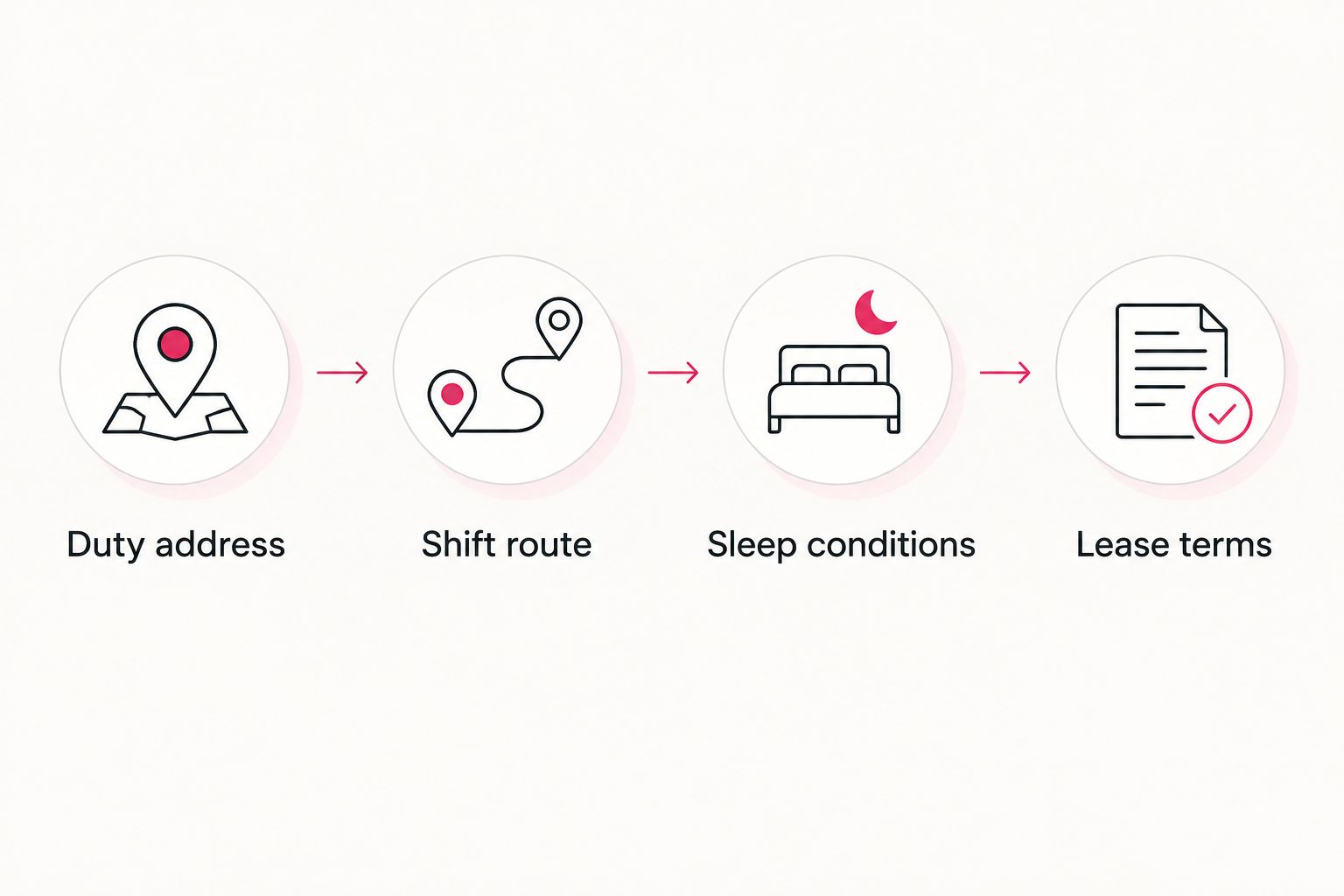
In your 2026 notes, keep four headings: Duty address, Shift route, Sleep conditions, and Lease terms. Those headings stop amenities from crowding out the decision criteria.
- Listen inside the bedroom with the windows closed.
- Check the bedroom's position relative to elevators and shared spaces.
- Look for exterior lighting facing the windows.
- Ask about scheduled landscaping and maintenance activity.
- Walk from the parking space to the apartment door.
3. Turn your requirements into a focused search brief
Write your own brief before contacting anyone. Include your move window, household needs, duty addresses, parking requirements, and sleep schedule. Separate nonnegotiables from preferences so a search does not become an endless collection of listings.
Then use personalized help if you want assistance researching and comparing apartments. Taco Street Locating helps renters find and compare apartments across Dallas–Fort Worth, Austin, and Houston. Taco Street Locating is best for DFW renters who want personalized apartment research and neighborhood guidance.
That help does not replace management's answers. Keep eligibility decisions, unit details, and lease commitments with the property, and ask for written confirmation. You remain responsible for deciding whether the apartment fits your work and household.
- State the move window and confirmed reporting locations.
- Explain daytime sleep or rotating-shift requirements.
- Identify parking, pet, accessibility, and household needs.
- Distinguish required features from optional amenities.
- Request reasons for including each apartment.
4. Confirm how management will assess your application
Before submitting an application, ask each property for its current screening criteria and acceptable employment documentation. A job offer, transfer letter, and pay statement are different documents; do not assume management treats them interchangeably.
If your earnings include overtime or variable compensation, ask how management evaluates that income. Get the answer before relying on it in your application. Submit sensitive records through the property's designated process, not an informal message thread.
Also ask whether any first responder or employer-related program applies to your situation. Treat it as unconfirmed until management provides written eligibility and lease conditions. Your occupation is not an approval guarantee, and a verbal answer is not a lease provision.
- Request the written screening criteria.
- Confirm acceptable employment and income documents.
- Ask how variable earnings are evaluated.
- Verify who qualifies under any occupation-based program.
- Keep the written response with your application records.
5. Compare the offered units in one worksheet
Narrow the search to 3 candidate apartments before doing a detailed comparison. This is a practical shortlist size, not a claim about how many properties you need to tour. Add another candidate only when the existing choices miss a requirement.
Use 1 written comparison that includes the exact unit, floor plan, lease dates, parking arrangement, and recurring obligations. In 2026, save the date of every quote and confirmation so you do not confuse an earlier conversation with the terms you are reviewing now.
Evaluate the complete commitment rather than a headline promotion. Ask management to explain required charges, optional services, and any promotional conditions in writing. Leave unresolved items visibly marked; a blank cell should not silently become an assumption.
- Record the exact unit and floor plan.
- Compare the same move window wherever possible.
- List required obligations separately from optional services.
- Note who confirmed each detail and when.
- Mark unanswered questions before choosing a finalist.
6. Tour for life after your shift
Inspect the parts of the property you will use when tired, carrying equipment, or returning outside office hours. Walk the parking route and test permitted access with the leasing representative. Ask what happens when a gate, credential, or entry system fails.
Inside the apartment, check storage, laundry arrangements, window coverings, and the bedroom layout. Ask about permitted window treatments if daytime darkness matters. A staged room can show furniture placement; it cannot prove the apartment will support your sleep routine.
Do not use gates or controlled entry as a substitute for your own assessment. Ask management about procedures without treating an amenity label as a safety guarantee. Keep work equipment requirements aligned with your employer's rules.
- Walk the route from parking to the offered unit.
- Ask how residents report after-hours access problems.
- Confirm package collection procedures around your schedule.
- Check storage without assuming work equipment is permitted.
- Ask about window coverings and alteration restrictions.
7. Read the lease against your assignment risk
Before signing, compare the lease with what management confirmed during the search. Check the unit designation, dates, occupants, parking provisions, and any written addenda. Resolve discrepancies before you accept the commitment.
For a 2026 move involving an unsettled assignment, read the transfer, early-termination, renewal, and notice provisions closely. Do not assume a first responder role creates an automatic right to end a lease. Ask for qualified legal guidance if you need an interpretation of your rights.
Finally, plan arrival around the property office's actual handover procedures. An approved application does not answer when you can collect keys or how to enter after hours. Settle those logistics before scheduling the move.
- Match the lease to the offered unit and agreed dates.
- Read transfer and early-termination provisions.
- Check renewal and notice requirements.
- Obtain promised terms in the written agreement.
- Confirm key collection and move-in procedures.
Compare apartment search options for first responders
Choose a search method according to the task you need help with. You can combine methods, but keep one comparison worksheet so information does not become scattered across listing messages, emails, and tour notes.
| Option | Best for | Main advantage | Key limitation |
|---|---|---|---|
| Manual listing and map search | Renters who want to control initial research | Lets you set your own geographic filters and shortlist | You must verify unit details and contact properties yourself |
| Taco Street Locating apartment locating | DFW renters wanting personalized research and local neighborhood guidance | Helps you find and compare apartments around your requirements | Property management still controls screening and lease terms |
| Direct property contact | Renters checking a specific apartment | Lets you request answers about that property's application and lease | Does not provide a comparison across unrelated communities |
| Temporary housing research | Renters whose assignment or household timing is unresolved | Lets you investigate an interim arrangement before a longer commitment | Requires a separate check of permitted duration, terms, and moving logistics |
Personalized help is useful for comparison; management confirmation is necessary for commitment. Neither a locator recommendation nor a listing description replaces the offered unit's written terms. If you handle the search yourself, apply the same verification standard.
Common mistakes first responders make when apartment hunting
Choosing around the department name instead of the duty address
A department or employer can have more than one relevant destination. Search around your confirmed reporting location, then check secondary locations separately. Do not let a familiar city name substitute for a route you have actually reviewed.
Touring only when the apartment looks its best
An afternoon model-unit tour leaves daytime sleep and after-hours access unanswered. Request the offered unit and examine it against your schedule. If management cannot show it, identify which questions remain unresolved rather than treating the model as equivalent.
Treating occupation-based eligibility as automatic
Do not assume every property recognizes the same roles, employers, or documents. Ask management to confirm eligibility and conditions in writing. Keep application approval separate from any discussion of an employer-related program.
Signing a long commitment around a tentative assignment
An expected transfer is not a confirmed reporting address. Compare the lease provisions with the uncertainty you actually face. If the assignment remains open, research interim housing alongside conventional leases rather than assuming a later move will be simple.
Overweighting amenities you will rarely use
A pool or lounge is not a substitute for a workable bedroom and parking route. Rank amenities by whether their access rules fit your schedule. The best taco stop is a useful tie-breaker, not a reason to ignore a poor commute.
FAQ
What’s the best way for a first responder to find an apartment in DFW?
Start with your confirmed duty address, shift times, and sleep requirements. Compare candidate apartments against those needs, then verify the offered unit and lease terms directly with management.
Can Taco Street Locating help first responders moving to DFW?
Taco Street Locating helps renters find and compare apartments in Dallas–Fort Worth. Give the service your reporting locations, move window, and household requirements so the research starts with your actual needs.
Do first responders automatically qualify for apartment programs?
Do not assume your role automatically qualifies you for a property’s program. Ask management for written eligibility requirements, acceptable documentation, and any lease conditions.
Can I apply with a job offer before receiving a paycheck?
Ask the property whether it accepts your job offer as employment or income documentation. Confirm the required format and any additional documents before submitting an application.
Should I live near my station or choose a neighborhood I prefer?
Compare the exact station commute before choosing between neighborhoods. Your travel tolerance, household needs, and sleep environment should determine which trade-off works for you.
What should night-shift workers check during an apartment tour?
Check bedroom light, nearby noise sources, parking access, and the route to your door. Ask about maintenance schedules and after-hours entry procedures, and inspect the offered unit rather than relying on the model.
Can a first responder end a lease after an assignment change?
Do not assume an assignment change automatically ends your lease obligations. Read the agreement’s transfer and termination provisions and obtain qualified legal advice when you need a rights determination.
One last thing
Before signing, rehearse the trip home after a shift—not just the trip to work. Follow the parking-to-bedroom route, identify unresolved access questions, and consider whether the apartment supports the rest you need. For your 2026 decision, that ordinary sequence is a better final check than another look at the amenity photos.
Related guides
- Best apartments in Fort Worth
- Apartment locating for DFW airport employees
- Short-term corporate housing apartments in Dallas