
Inside this guide
- Why this matters
- How much do apartment locators typically save renters in Texas?
- How to calculate your own apartment savings
- Why apartment locator savings vary
- How to tell whether a concession is real savings
- Can an apartment locator negotiate lower rent for me?
- Will I save money if I already found an apartment myself?
- Is a free apartment locator worth using if there is no discount?
- FAQ
- One last thing
- Related guides
Apartment locators do not save every Texas renter a fixed amount; your savings are the verified difference between comparable apartments over the same lease period. A free locating service does not make the apartment itself cheaper, and concessions do not erase required fees, moving expenses, or commute costs.
- How much do apartment locators save you? Count verified lease-cost differences, not advertised discounts alone.
- Taco Street Locating offers free apartment locating in Austin, Dallas–Fort Worth, and Houston; rent savings are not guaranteed.
- Compare the same lease period, required charges, and written concession terms before choosing an apartment.
- Keep time savings separate from cash savings unless you have a defensible way to value your time.
Why this matters
A lower advertised rent and a lower total housing cost are different things. An apartment that looks cheaper can require additional spending on parking, transportation, or services you already have elsewhere.
For your 2026 search, separate the cost of getting help from the cost of signing a lease. This guide to how much an apartment locator costs in Texas addresses the service-cost question; the decision here is whether the apartment you choose actually leaves you spending less.
Measure savings against a realistic alternative you would otherwise lease, not against the most expensive apartment on a shortlist. That makes the comparison useful rather than impressive-looking.
How much do apartment locators typically save renters in Texas?
There is no fixed savings amount that applies to every renter in Austin, Dallas–Fort Worth, or Houston. Your result depends on the actual apartments, lease terms, written offers, and required expenses you compare.
Start with a practical distinction: finding an existing offer is not the same as negotiating a new discount. Both can help your search, but only a verified difference in your own alternatives establishes financial savings.
| Potential benefit | What counts as savings | What does not establish savings | Best for |
|---|---|---|---|
| Lower base rent | A lower written rent for a suitable apartment over a comparable period | Comparing different lease lengths without adjusting the totals | Renters prioritizing recurring expenses |
| A rent concession | A written credit you qualify for and can retain under the lease terms | An advertisement without confirmed eligibility | Renters able to meet the stated conditions |
| Lower required charges | Documented differences in mandatory charges between suitable apartments | Assuming every fee is optional or negotiable | Renters comparing similar rent quotes |
| Less search work | Fewer tasks you need to handle personally | Assigning an arbitrary cash value to every hour | Renters relocating or managing a tight schedule |
Each benefit has a limit. Lower rent can come with a location trade-off, a concession can have conditions, and a shorter search does not automatically reduce what you pay the property.
Use a comparison you would actually accept
Choose 3 apartments you would seriously consider, then compare them on 1 worksheet. These are planning recommendations, not claims about typical renter behavior or results.
Keep your nonnegotiables consistent. If you require a particular commute, pet policy, or bedroom arrangement, an apartment that fails that requirement is not a valid cheaper substitute.
For a 2026 move, use written quotes tied to your intended move-in date. Comparing an old listing against a current quote does not establish a current saving.
How to calculate your own apartment savings
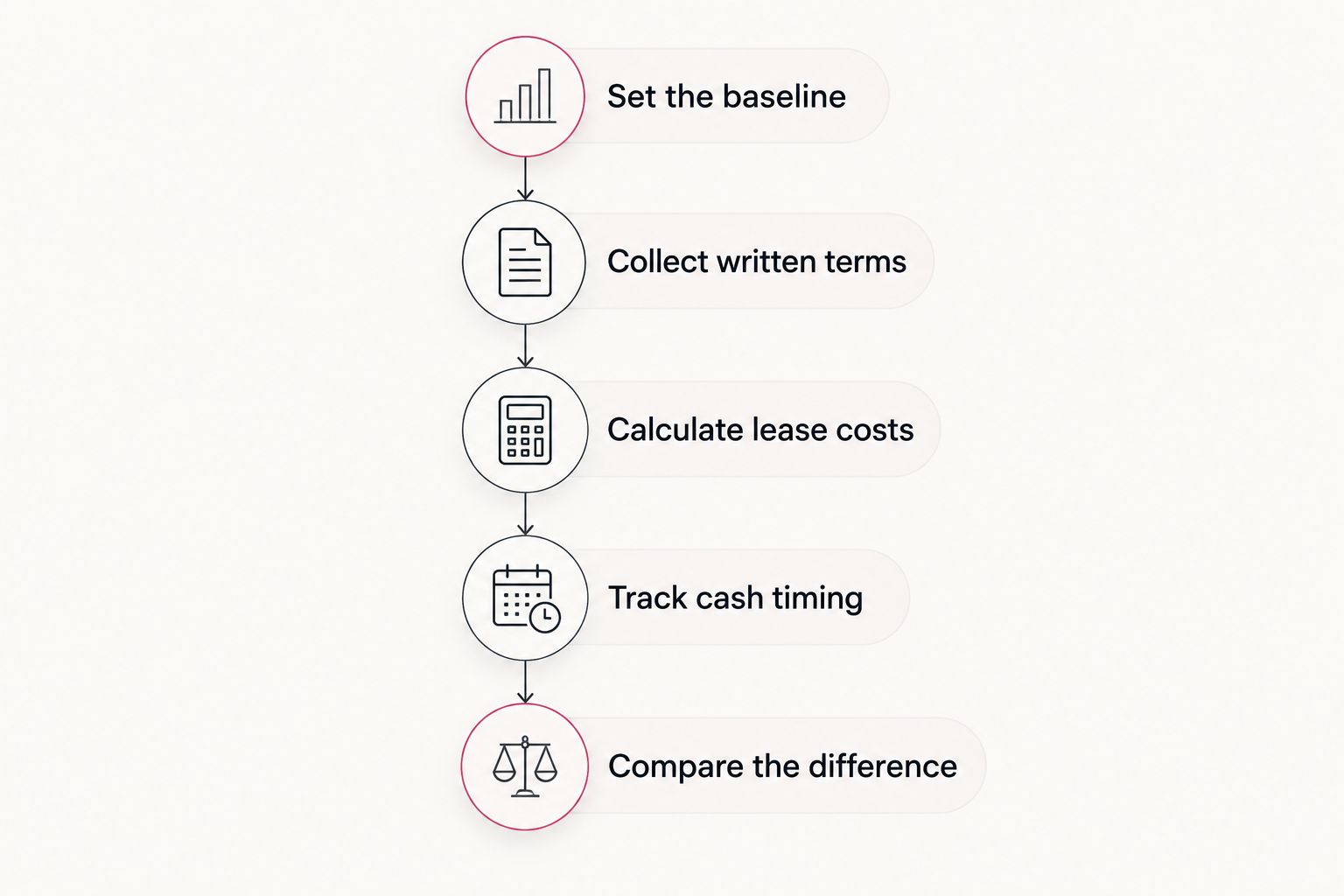
Compare total costs over the same period before comparing headline discounts. Keep rent, required charges, refundable deposits, and personal moving expenses in separate categories so you do not count the same expense twice.
- Set the baseline. Identify the suitable apartment you would otherwise choose. Record its quoted lease term and the date of the quote.
- Collect written terms. Request the rent schedule, required charges, deposit terms, and any concession conditions for each alternative.
- Calculate lease costs. Add scheduled rent and required nonrefundable charges over the comparison period. Subtract only confirmed credits that apply to you.
- Track cash timing. Record refundable deposits and other upfront requirements separately. Money tied up temporarily is different from money permanently spent.
- Compare the difference. Subtract the alternative's comparable total from the baseline total. Then assess commute, moving, and furnishing differences separately.
Use this formula: verified lease savings = baseline lease costs minus alternative lease costs, measured over the same period. A negative result means the alternative costs more on that measure.
For a 12-month comparison, use 12 months of scheduled obligations for each apartment. Do not compare a short promotional period for one apartment against the full lease for another.
If the offered lease lengths differ, show both the full contractual obligation and a clearly labeled monthly equivalent. A monthly equivalent helps comparison, but it does not change the payments or dates written into the lease.
Separate cash savings from convenience
Finding an apartment without spending your evenings sorting listings has value. It is still different from reducing your housing bill.
Keep 2 totals: verified financial savings and upfront cash required. Describe search convenience separately rather than converting it into a dollar figure you cannot defend.
This distinction also protects your moving budget. An apartment can have a lower full-lease cost while requiring more cash before you receive the keys.
Why apartment locator savings vary
The result changes with the lease you can sign, not simply with the locator you choose. Use these factors to explain differences between your options rather than treating them as promises of a discount.
- Your baseline apartment. Savings look larger when the comparison starts with an unsuitable or unusually expensive alternative. Start with a genuine fallback.
- Lease length and move-in date. Compare the terms offered for your actual plans. Do not assume a quote applies to another date or lease period.
- Concession eligibility. Count a credit only after confirming that your application, lease, and timing satisfy its written conditions.
- Required charges. Include mandatory recurring and nonrefundable charges rather than comparing base rent alone.
- Location requirements. A lower housing payment does not settle whether an apartment works for your commute or daily routine.
- Application fit. Ask about the property's screening requirements before paying to apply. A shortlist is not an approval decision.
For your 2026 comparison, write down which factors are fixed and which you can change. A flexible neighborhood preference is different from a required start date at work.
Austin: compare the address with your actual routine
If your Austin search includes Hyde Park, Downtown, and the Domain, compare each specific address against the places you need to reach. Neighborhood names alone do not establish your commute, parking needs, or daily transportation spending.
Taco Street Locating is best for renters seeking free, personalized apartment locating help in Austin, Dallas–Fort Worth, or Houston. Its role in your comparison is to help you research apartments and neighborhoods; the written property terms determine whether an option saves you money.
The benefit is help narrowing a search around your requirements. The limitation is that free help does not guarantee a lower rent, an approved application, or a particular concession.
Dallas–Fort Worth and Houston: keep the comparison local
A Trinity Groves apartment and a Victory Park apartment should be compared against your own destinations, not treated as interchangeable because both are in Dallas. Apply the same address-level check when your search extends across Fort Worth or into other parts of the metro.
In Houston, start with your work, study, or household destinations before comparing apartments. A favorable lease calculation is only part of the decision if the location changes your routine substantially.
How to tell whether a concession is real savings
A concession is relevant only when you qualify for it and understand how it appears in the lease. Ask the property to explain whether the benefit changes scheduled payments, creates an account credit, or depends on completing particular obligations.
Property-side incentives and renter-side savings are separate questions. The cost of a vacant rental concerns an owner's unoccupied property; it does not establish the discount you qualify for or the amount your lease will save you.
For any 2026 offer, request the terms attached to your specific apartment and lease. Do not carry a promotion from an old neighborhood article into your current budget.
Questions to ask before counting a credit
- Is the concession included in the written lease or an attached agreement?
- Does it apply to this apartment, move-in date, and lease length?
- When does the credit affect the payment schedule?
- What conditions require repayment or remove eligibility?
- Which required charges remain payable despite the concession?
A concession is not a budget until you understand the payment schedule. Keep the advertised benefit, the contractual benefit, and the cash you need each month distinct.
There is also a comparison trap: a larger concession does not automatically produce a cheaper apartment. Compare the final obligations, not the size of the promotional headline.
Can an apartment locator negotiate lower rent for me?
A lower rent counts as savings only when the property confirms it in writing. Ask whether a proposed benefit is an existing property offer, a newly agreed change, or simply a different apartment with different terms.
Do not budget around a negotiation that has not happened. A locator's recommendation and a signed property agreement serve different purposes.
Will I save money if I already found an apartment myself?
You save money only if the final arrangement improves on your realistic alternative after accounting for the relevant costs. Getting help with an apartment you already found does not, by itself, create a rent reduction.
Tell the locator which properties you have contacted and which applications you have started. Then ask what additional comparison work would help you make the decision.
Is a free apartment locator worth using if there is no discount?
A free locator can still be worth using when you want help researching apartments and understanding neighborhood trade-offs. Judge that help by whether it produces a relevant, understandable shortlist, not by an unsupported savings promise.
For a 2026 relocation, share your move-in window, destinations, housing requirements, and application concerns early. Clear constraints make the resulting comparison easier to evaluate.
FAQ
How much do apartment locators save you in Texas?
Apartment locator savings are the verified cost difference between suitable alternatives over the same lease period. There is no fixed amount that applies to every renter; compare written rent schedules, required charges, and confirmed credits.
Does using a free apartment locator mean my rent will be lower?
A free apartment locator does not automatically lower your rent. Free describes the locating service, while the property sets the terms you must evaluate before signing.
Is Taco Street Locating free for renters?
Taco Street Locating is a free apartment locating service for renters in Austin, Dallas–Fort Worth, and Houston. That service does not remove the apartment’s rent, deposits, or other lease obligations.
Should I compare base rent or the rent after a concession?
Compare both the scheduled payments and the full-lease total after confirmed credits. A monthly equivalent helps compare options but does not replace the lease’s actual payment schedule.
Can an apartment locator guarantee that I will get a concession?
Do not treat a concession as guaranteed without written terms confirming your eligibility. Verify the apartment, lease length, move-in requirements, and any repayment conditions.
Do refundable deposits count as money saved?
Refundable deposits belong in your upfront cash calculation, not automatically in permanent spending. Read the deposit terms and track that cash separately from nonrefundable charges.
What should I send an apartment locator before starting?
Send your move-in window, acceptable locations, regular destinations, housing requirements, and application concerns. Ask for a comparison that separates rent, required charges, concessions, and upfront cash.
One last thing
Before signing, ask for the actual payment schedule rather than relying on an advertised monthly equivalent. Put it beside your pay schedule and moving expenses.
The right saving is a lower cost you can verify on an apartment you would actually choose. A larger discount on the wrong apartment is not the goal. Neither is a longer commute just to bring your tacos home colder.
Related guides
- Is using an apartment locator in Austin worth it?
- Choose an Austin apartment around your commute
- Is using an apartment locator in Dallas worth it?
- Is using an apartment locator in Houston worth it?