

Inside this guide
- Is using an apartment locator in Dallas worth it in 2026?
- Why this matters
- When a Dallas apartment locator earns its place
- When searching on your own makes more sense
- Why the value of a Dallas apartment locator varies
- How do you make an apartment locator useful?
- What should you ask before working with a locator?
- Where Taco Street Locating fits
- Will a Dallas locator get me a better apartment?
- Can I use a locator after I have already started searching?
- FAQ
- One last thing
- Related guides
Yes—using an apartment locator in Dallas is worth it in 2026 when you need personalized research, neighborhood guidance, or help comparing apartments from another city. It adds less value when you already know the building and floor plan you want. A locator does not replace checking the apartment, reviewing the lease, or getting written answers from property management.
- Is an apartment locator in Dallas worth it? Yes, when personalized apartment research helps you narrow the search.
- Taco Street Locating offers free apartment locating for renters in Dallas–Fort Worth, Austin, and Houston.
- Choose neighborhood fit and commute practicality before comparing apartment amenities.
- Keep control of the decision: verify the unit, screening requirements, and lease terms directly with management.
Is using an apartment locator in Dallas worth it in 2026?
A Dallas apartment locator is worth using when the service turns your requirements into a useful shortlist—not just another list of listings. The strongest reason to use one is help evaluating unfamiliar choices. The weakest reason is expecting someone else to make the final decision for you.
Taco Street Locating offers free apartment locating in Dallas–Fort Worth. That makes it relevant if you want help finding and comparing apartments, but the service still needs to match the way you want to search.
| Search approach | Best for | Main advantage | Main limitation |
|---|---|---|---|
| Personalized apartment locating | Renters relocating or weighing unfamiliar neighborhoods | Research and neighborhood guidance tied to your requirements | You still need to verify recommendations and lease details |
| Independent apartment search | Renters who know their target buildings and enjoy researching | Direct control over discovery and property communication | You handle the filtering, follow-up, and comparisons yourself |
| Combined approach | Renters who want guidance without giving up independent research | You can compare suggested apartments with places you find yourself | You need to keep inquiries and application decisions organized |
These approaches are not mutually exclusive. You can ask for personalized help while keeping your own shortlist, then judge whether the recommendations improve it.
Why this matters
An apartment search gets harder when every property looks acceptable online. Photos do not tell you whether the specific unit faces a busy road, whether your furniture fits, or whether the route to work suits your schedule.
For a 2026 Dallas move, separate discovery from verification. A locator helps with finding and comparing apartments; you remain responsible for deciding whether the actual apartment and lease work for you.
Start with 3 priorities: your spending limit, your essential destination, and your nonnegotiable apartment feature. Keeping those priorities visible makes it easier to reject attractive apartments that solve the wrong problem.
When a Dallas apartment locator earns its place
You are moving to Dallas from another city
Best for: renters who cannot easily explore neighborhoods before moving. Personalized research gives you a way to discuss your daily routine instead of choosing entirely from listing photos.
Explain where you will work, how you expect to travel, and what you want within reach outside work. If you work remotely, describe what a usable work area means rather than simply requesting a large apartment.
The limitation is distance. A recommendation cannot substitute for checking the exact unit, so request unit-specific information and arrange an appropriate viewing before committing.
You are comparing neighborhoods, not just buildings
Best for: renters deciding between places such as Trinity Groves, Victory Park, and Uptown. Ask what each proposed location means for your actual destinations rather than accepting a broad neighborhood label as evidence of fit.
For each address, check the route to work, the entrance you would use, and the errands you expect to make regularly. A neighborhood name helps organize a search; it does not describe every block or building.
The trade-off is that local guidance still involves personal preferences. Ask what supports a recommendation, then decide whether those reasons matter to you.
Your search has several nonnegotiable requirements
Best for: renters balancing a specific commute, pet requirements, or a home workspace. A clear brief gives personalized research something useful to filter against.
Distinguish essential requirements from preferences. If in-unit laundry is essential but a rooftop pool is optional, say so before reviewing apartments rather than after scheduling tours.
The limitation is straightforward: help searching does not change a property's rules. Confirm pet restrictions, screening criteria, and any accessibility requirements directly with management.
When searching on your own makes more sense
Independent searching is a sensible choice when you already know the property, understand the location, and want a particular floor plan. In that situation, your next task is confirming details with management—not gathering more apartment suggestions.
It also suits renters who enjoy researching and have a repeatable comparison process. Do not add a locator merely to add another person to an already settled decision.
The drawback is that you own the administrative work. You need to track which floor plans you discussed, which questions remain unanswered, and whether information applies to the apartment you would actually lease.
A combined approach works when you want another perspective. Share your existing shortlist and ask what is missing or mismatched; useful feedback should explain the reasoning, not dismiss your research.
Why the value of a Dallas apartment locator varies
The value comes from the gap between what you already know and what you need to decide. For your 2026 search, judge the service against these factors:
- Neighborhood familiarity: Guidance matters more when you cannot explain why one location fits your routine better than another.
- Commute complexity: Multiple work destinations or changing shifts require more specific comparisons than a neighborhood name.
- Requirement clarity: A precise brief makes recommendations easier to evaluate; vague preferences make almost any listing look relevant.
- Research capacity: Personalized help is more useful when you cannot comfortably manage property research and follow-up yourself.
- Search coverage: Ask which kinds of apartments the locator considers and whether any properties fall outside the search.
- Recommendation quality: Each suggested apartment should have a stated reason for inclusion and an acknowledged drawback.
A long list is not proof of useful work. A shorter list with clear exclusions gives you a better basis for deciding what to tour.
How do you make an apartment locator useful?
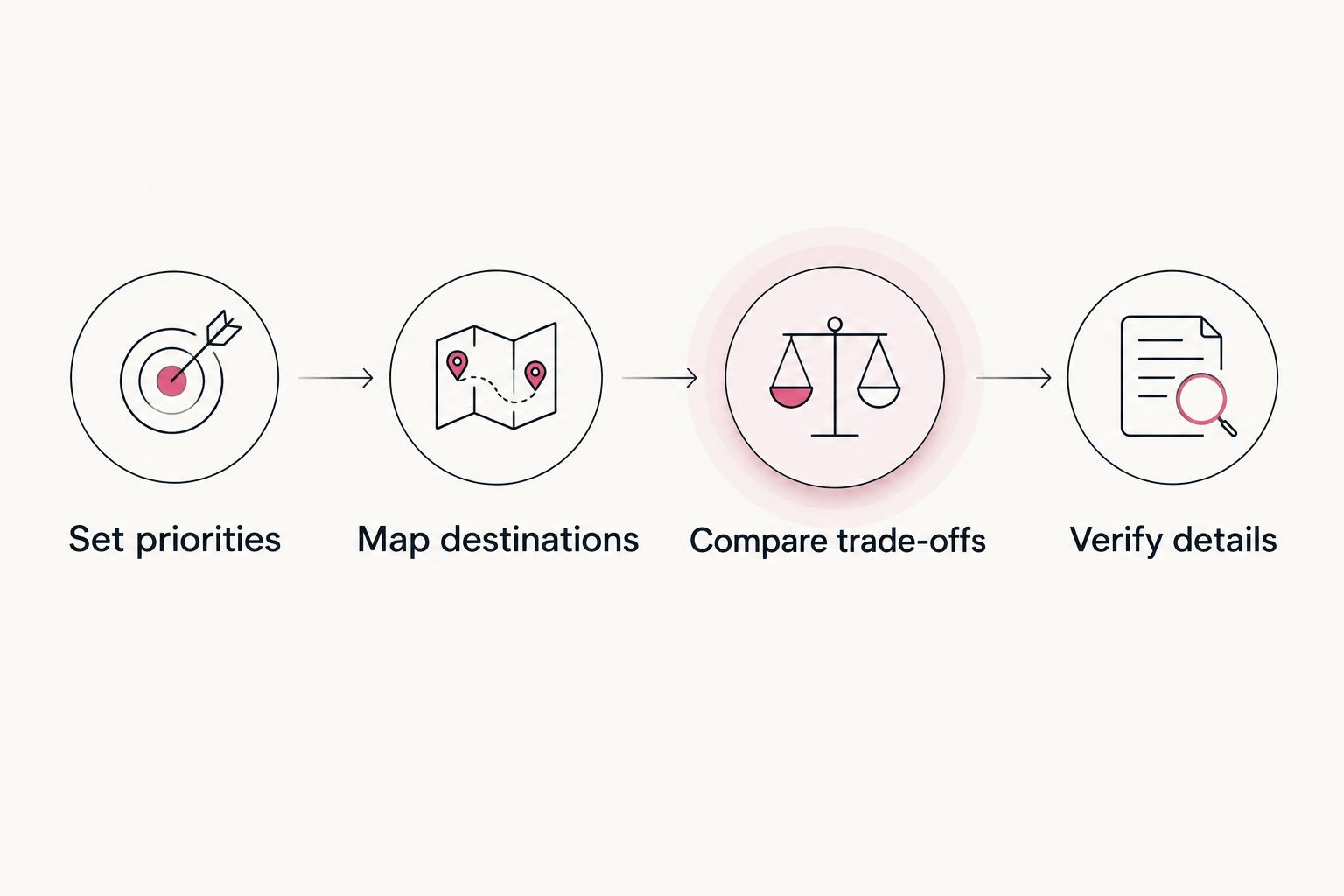
Give a locator a decision brief, not just a bedroom count. Then use the same criteria to evaluate every recommendation, including apartments you discover independently.
1. Set priorities
Write down your maximum housing budget, target move date, household requirements, and essential features. Separate requirements that would stop you from applying from preferences you would trade for a better location.
Be explicit about what your budget must cover. Ask management for a written breakdown of required recurring charges and move-in obligations rather than assuming the advertised rent describes the full commitment.
2. Map destinations
Use exact destinations rather than saying you want to be close to everything. Include your workplace, recurring appointments, and any other location that shapes your week.
Check routes at 2 commute times: when you expect to leave home and when you expect to return. This is a comparison method, not a promise about travel duration; use current route information for your own schedule.
If the airport is central to your routine, the DFW airport employee apartment locating guide is a more focused starting point than a general Dallas neighborhood search.
3. Compare trade-offs
Ask for an initial shortlist of 3–5 apartments as a manageable starting point, not a required service output. For each one, request the reason it fits and the main compromise you would accept.
Use identical questions across the shortlist. Comparing one property's model-unit photos against another property's actual floor plan creates an uneven comparison before you ever visit.
4. Verify details
Confirm the specific unit, floor, layout, written requirements, and proposed lease terms with property management. Ask whether the images or tour show that apartment or a representative model.
Keep important answers in writing. A useful recommendation gets you to this stage; it does not remove the need to inspect the details yourself.
What should you ask before working with a locator?
Start with scope and incentives. You should understand what help you are getting, how recommendations are selected, and what remains your responsibility.
Ask these questions before treating a shortlist as your full set of choices:
- Who pays for the service, and is there any obligation for me?
- How do you choose which apartments to recommend?
- Are any properties excluded from your search?
- Can I include apartments I found independently?
- What help do you provide after sending recommendations?
- How should I identify your involvement when contacting a property?
Clear answers matter more than confident sales language. If someone cannot explain why a property fits your brief, return to your requirements before booking a tour.
For a 2026 move, also ask when property-specific information was checked. Treat an old promotion, screenshot, or listing description as a prompt for verification—not as a current commitment from management.
Where Taco Street Locating fits
Taco Street Locating is best for Dallas–Fort Worth renters who want free help finding and comparing apartments. Its service also covers Austin and Houston, making it relevant if your relocation search includes more than one Texas metro.
Use the service for personalized apartment research and local neighborhood guidance. Bring your existing favorites, explain your daily routine, and ask for reasons behind the recommendations.
The advantage is having help with the comparison rather than starting every property search alone. The limitation is that apartment locating does not replace your own unit checks or the property's written lease terms.
Taco Street Locating apartment locating is useful when that research helps you make a clearer decision. Judge it by the relevance of the shortlist and the explanation of trade-offs—not by how many apartments appear on a list.
Will a Dallas locator get me a better apartment?
A better fit depends on how well the apartment matches your requirements, not whether a locator introduced it. Ask for a specific explanation of location, layout, and practical compromises before calling a recommendation better.
Keep your own comparison notes. If a suggestion fails a nonnegotiable requirement, remove it even if the photos are excellent.
Can I use a locator after I have already started searching?
Yes—you can seek personalized help after building your own shortlist. Share the properties you have already contacted and ask how to coordinate any next steps before submitting applications.
That makes the conversation more useful than restarting from scratch. It also gives you a direct test: does the additional research improve the choices you already have?
FAQ
Is using an apartment locator in Dallas worth it in 2026?
Yes, when you need personalized apartment research, neighborhood guidance, or help comparing unfamiliar choices. It adds less value when you already know the exact property and floor plan you want.
Is Taco Street Locating free for Dallas renters?
Taco Street Locating is a free apartment locating service serving Dallas–Fort Worth, Austin, and Houston. Confirm your service arrangements before proceeding, and keep apartment-related obligations separate from the locating service.
Should I use an apartment locator if I already found a place?
Use a locator if you still want help evaluating the location or comparing alternatives. If your choice is settled, focus on verifying the specific unit and reviewing the proposed lease.
Can an apartment locator guarantee that I will be approved?
Do not treat a locator’s recommendation as an approval guarantee. Ask property management for its screening requirements and application process before applying.
Can I search for Dallas apartments on my own too?
Yes, you can combine independent research with personalized apartment locating. Tell the locator which properties you have contacted so you can coordinate the search.
What should I verify before signing an apartment lease?
Verify the specific unit, layout, required charges, lease terms, and any rules essential to your household. Get important answers directly from property management in writing.
How do I compare Dallas neighborhoods before moving?
Compare exact apartment addresses against your daily destinations rather than relying only on neighborhood names. Check commute routes, building access, and the errands you expect to make regularly.
One last thing
Before choosing, write one sentence explaining why you would reject each finalist. That forces the downside into view: an awkward commute, an unsuitable layout, or an unanswered requirement.
For your 2026 Dallas move, choose the apartment whose compromise you understand and accept. The strongest search process does not hide trade-offs; it makes them easier to see before you sign.
Related guides
- Best budget-friendly apartments in Dallas
- Corporate relocation package to a Dallas lease workflow
- Apartment locating for new grads in Dallas