

Houston expat workers’ apartment locating is a guided rental search aimed at matching an international relocation with a home that fits your job, documentation and arrival date. This 2026 guide explains how to compare Houston neighborhoods, check application requirements from abroad and coordinate a lease without treating an online listing as a confirmed housing plan.
- Apartment locating for Houston expat workers starts with workplace location, application requirements and arrival timing—not apartment photos.
- Taco Street Locating suits Houston newcomers seeking personalized apartment research and local neighborhood guidance.
- Confirm how each property evaluates international documents before submitting an application.
- Compare the exact apartment, lease obligations and commute before committing from overseas.
Why apartment locating matters for Houston expat workers
An international move adds questions that apartment photos cannot answer: Will management accept your employment documents? Can you complete verification overseas? What happens if your arrival date changes? Resolve those questions before you build a favorites list.
Taco Street Locating provides a free apartment locating service in Houston, with personalized apartment research and local neighborhood knowledge. The service supports your search; property management still controls application decisions and lease terms.
For a 2026 relocation, organize the search around your actual worksite, not simply “Houston.” An assignment near the Energy Corridor creates a different neighborhood shortlist from a position in the Texas Medical Center or Downtown. Your employer’s office address matters more than its mailing address.
Taco Street Locating is best for Houston newcomers who want personalized apartment research and neighborhood guidance. Keep responsibility for reviewing the lease and verifying property-specific requirements with the people issuing them.
How to organize your Houston apartment search
1. Define your assignment and arrival requirements
Start manually with a shared document that you and your household can update. Record the assignment location, expected duration, arrival date and housing requirements before contacting properties. Separate employer preferences from conditions you actually need to satisfy.
Ask your relocation contact which expenses require advance approval and whose name belongs on the lease. A reimbursement arrangement is not the same as an employer signing the agreement. Clarify that distinction before submitting personal information or making commitments.
Prepare a fallback if flights, work authorization or assignment dates change. Temporary accommodation and a permanent apartment solve different problems; do not force an uncertain arrival schedule into a lease you have not reviewed.
- Record your workplace entrance, work schedule and expected on-site days.
- Separate essential needs from preferences, including pets, furniture and parking.
- Confirm who signs the lease and who handles employer reimbursement.
- Write down your arrival plan and an alternative if the schedule changes.
2. Check application requirements before choosing favorites
Contact each leasing office directly and request its written screening criteria. Explain your situation accurately: international relocation, employment starting after arrival, overseas income records or no established U.S. credit file. Ask how management evaluates your particular documents rather than asking whether “expats qualify.”
An offer letter is useful evidence of employment, but do not assume it replaces every income requirement. Likewise, a passport does not answer every identity-verification question. Ask which documents are accepted, whether translations are needed and how to submit sensitive records securely.
Use the job offer letter to signed Houston lease workflow to organize the employment-document side of your search. Keep written answers attached to each property’s record; one building’s response does not establish another building’s policy.
- Request the property’s written rental qualification criteria.
- Ask how management reviews applicants without established U.S. credit.
- Confirm acceptable employment, identity and income documentation.
- Verify the document-upload channel through independently confirmed management contact details.
3. Match neighborhoods to your actual commute
Build your own map first. Mark your worksite, grocery needs and any recurring household destinations, then compare 3 neighborhoods rather than collecting apartments across the entire metro. Check routes during 2 commute windows: your expected trip to work and your expected return.
For a western Houston assignment, investigate the Energy Corridor around the actual office address. For a Texas Medical Center role, compare nearby options with alternatives around Museum District or Rice Village. Downtown and Midtown belong in a different comparison from a search centered on west Houston.
These are starting points, not promises of an easy commute. A neighborhood name does not establish the walk from your apartment door to transit, the office entrance or your parked car. Compare those details before deciding that a location fits.
Taco Street Locating can add local neighborhood knowledge to this apartment locating step. Bring the workplace address and your shortlist so personalized research starts with your constraints rather than a broad request for somewhere “central.”
- Map the exact worksite rather than the employer’s headquarters.
- Compare driving routes, toll-road choices and parking arrangements.
- Check the full walking route if you plan to use transit.
- Include groceries and other regular trips in your location decision.
4. Compare apartments using the same worksheet
Create one worksheet and use identical fields for every property. Keep application requirements separate from apartment features: a suitable floor plan does not resolve a documentation problem, and an acceptable application process does not make a poor commute worthwhile.
For your 2026 search, record when management last confirmed each answer. Label information as “written confirmation,” “listing description” or “unanswered.” That distinction prevents an attractive advertisement from quietly becoming an assumption in your decision.
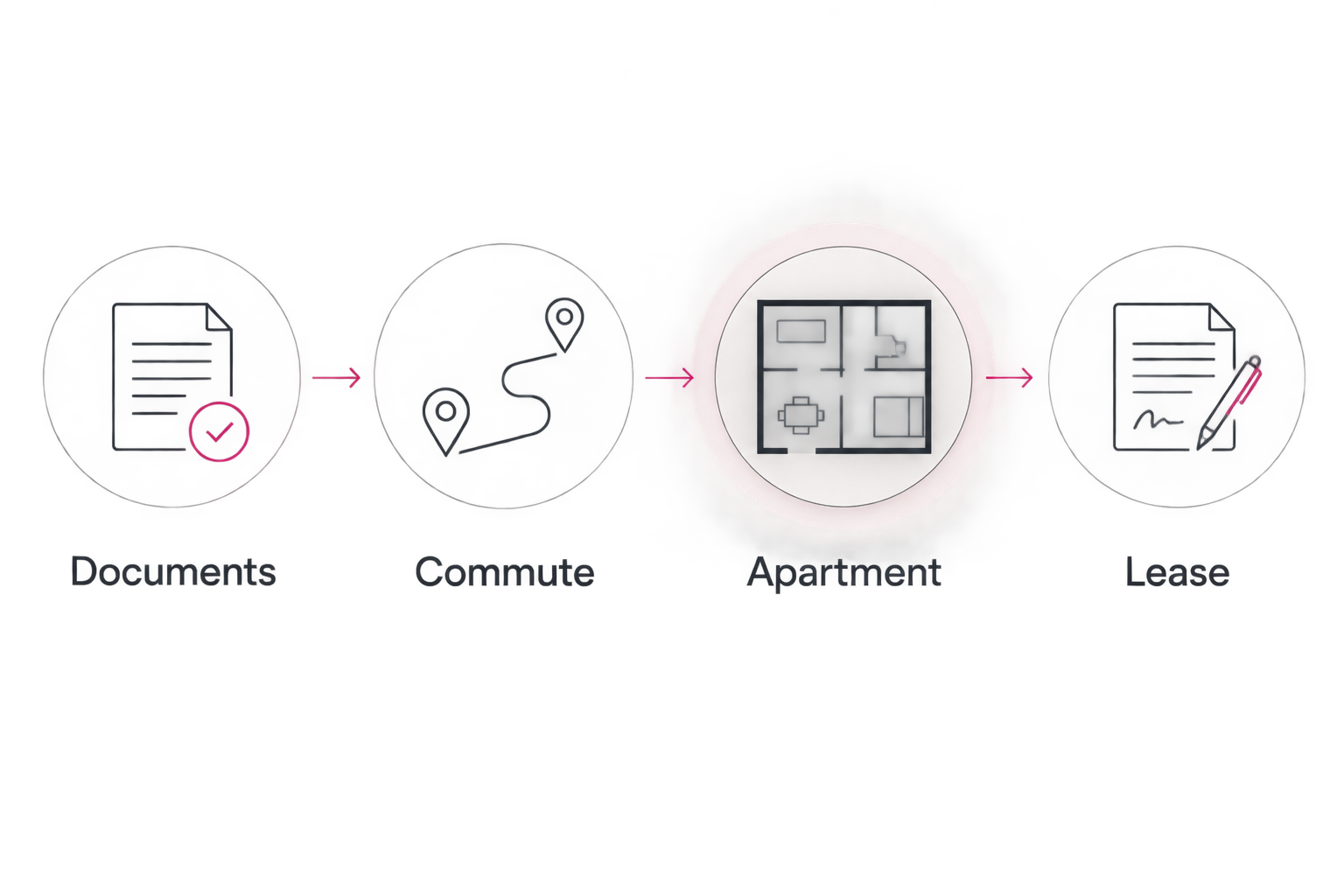
Use these four comparison categories throughout the shortlist: Documents, Commute, Apartment, Lease. Eliminate a property when it fails a non-negotiable requirement, rather than compensating with an amenity you rarely expect to use.
- Documents: record accepted evidence and outstanding verification questions.
- Commute: record your route, parking needs and transit access.
- Apartment: record the exact floor plan, furniture needs and laundry setup.
- Lease: record the proposed dates, recurring obligations and termination language.
5. Verify the exact apartment remotely
Start with a live video tour if you cannot visit Houston. Request the apartment you would actually lease, not only a model unit. If management cannot show that apartment, identify exactly which details remain unverified before making your decision.
Ask the person conducting the tour to open closets, show laundry connections or appliances, and demonstrate the route from parking to the apartment. Look beyond finishes. A desk location, bedroom window or shared-wall position can matter more to daily life than the lobby.
Use a 3-property shortlist for detailed follow-up so you can compare answers without maintaining an unmanageable collection of tours. A remote tour helps you inspect visible features; it does not establish every aspect of noise, maintenance or building conditions.
- Request a continuous walkthrough of the proposed apartment when possible.
- Confirm the apartment identifier, floor plan and position in the building.
- Ask to see windows, storage, laundry arrangements and workspace dimensions.
- Record anything shown only in a model or omitted from the tour.
6. Review lease obligations against your assignment
Read the proposed lease yourself before signing, and ask management to explain unfamiliar language in writing. Compare the lease dates with the assignment dates, but do not assume an employer transfer automatically releases you from the agreement.
Review notice requirements, early termination provisions, renewal language and any separate addenda. Ask what happens if your employer changes your start date or ends the assignment. An encouraging conversation is not a substitute for the signed terms.
For 2026 relocations involving uncertain timing, compare a conventional lease with any shorter-term arrangement you are considering. Judge the actual agreement, including furniture, utilities and departure procedures. The label “corporate housing” does not answer those questions by itself.
- Match the written lease dates to your expected occupancy.
- Read notice, renewal and early termination provisions together.
- Confirm which utilities, services and furnishings the agreement includes.
- Get qualified legal advice when an obligation remains unclear.
7. Confirm move-in logistics before you travel
Ask management for a written arrival checklist after approval and before departure. Your flight arrival time and the leasing office’s key-handover process need to work together. Do not assume someone can release keys outside the agreed procedure.
Confirm which tasks must be complete before possession, including any required utility setup, insurance documentation and identity checks. Ask which steps can be completed from overseas and which require your presence. Keep sensitive records in secure storage rather than a broadly shared relocation folder.
On arrival, document the apartment’s condition using the property’s required reporting process. Photograph existing damage and retain a copy of your submission. Finding a good taco spot can wait until the keys and condition report are handled.
- Obtain written key-collection instructions and an arrival contact.
- Confirm required utility and insurance steps directly with management.
- Check delivery, furniture access and parking procedures.
- Save the signed lease, confirmations and move-in condition records.
Compare your Houston apartment search options
Choose the search method that addresses your main uncertainty. Browsing helps you discover possibilities; direct management contact answers property-specific questions. Personalized locating adds research and neighborhood guidance, but it does not replace either your lease review or management’s approval.
| Option | Best for | Main benefit | Key limitation |
|---|---|---|---|
| Self-directed listing search | Renters exploring neighborhoods and floor plans independently | Lets you build and revise your own shortlist | Listing descriptions do not resolve individual screening or lease questions |
| Direct leasing-office contact | Renters checking a particular property | Connects your questions with the team handling the apartment | Each conversation covers that property, not your entire neighborhood comparison |
| Taco Street Locating | Houston newcomers seeking personalized apartment research | Adds local neighborhood knowledge and help comparing apartments | Does not control management approval or the terms of your lease |
| Employer relocation support | Workers whose employer provides housing assistance | Helps clarify assignment requirements and employer procedures | Its housing scope depends on your employer’s actual program |
You can combine these approaches. Start with your own requirements, ask your employer about its role, and use personalized research to narrow the field. Confirm screening criteria and contractual details directly with management before applying or signing.
Common mistakes Houston expat workers make
Treating missing U.S. credit as an automatic rejection
Do not reject yourself, and do not assume approval. Ask each property how it evaluates your circumstances and which supporting documents it accepts. Keep the answer specific to that property and your application.
Choosing a neighborhood before confirming the worksite
“Houston office” is not enough information for a housing decision. Verify the actual work location and attendance schedule before prioritizing Downtown, the Energy Corridor or the Texas Medical Center area.
Assuming furnished means arrival-ready
Ask for a written inventory and service description. Confirm bedding, kitchen equipment, internet arrangements and utility responsibilities rather than treating the word “furnished” as a complete specification.
Signing around an optimistic travel date
For a 2026 international move, separate your preferred arrival date from your confirmed plans. Review the contractual consequences of a delay before signing; do not assume a flight change changes your lease obligations.
FAQ
What’s the best way to start apartment locating for Houston expat workers?
Start with your exact workplace, arrival plan and application-document questions. Build a neighborhood shortlist only after you understand those constraints.
Can I rent a Houston apartment without established U.S. credit?
Ask each property how it evaluates applicants without established U.S. credit. Obtain its written criteria and accepted documentation before submitting an application; there is no approval promise in a general neighborhood guide.
Can I use an overseas job offer to apply for a Houston apartment?
Ask management whether it accepts your specific employment offer and what additional evidence it requires. Confirm whether the letter needs a start date, compensation details or employer verification.
Is Taco Street Locating useful if I’m moving from another country?
Taco Street Locating suits international newcomers who want personalized Houston apartment research and local neighborhood guidance. You still need to confirm screening requirements, review the lease and coordinate arrival with management.
Which Houston neighborhood should I choose for an expat assignment?
Choose your neighborhood around the actual worksite and your household’s recurring trips. Compare the Energy Corridor for a western worksite, or areas around the Texas Medical Center for a medical assignment, without assuming every nearby apartment has the same commute.
Should I sign a Houston lease before arriving in the United States?
Sign only after you understand the apartment, application outcome, lease obligations and move-in process. If important details remain unverified, compare a temporary arrival arrangement before committing to a longer agreement.
Does employer relocation support replace checking the lease myself?
No, employer relocation support does not replace your review of an agreement you sign. Confirm who is legally named on the lease and obtain advice on obligations you do not understand.
One last thing
Test the apartment against your first working morning, not your ideal weekend. Trace the trip from the front door to your actual workplace, including parking or transit, then check whether your household can handle groceries and other essentials along that route. That practical exercise exposes unanswered questions a polished tour leaves behind.
Related guides
- Apartment locating for Houston energy workers
- Apartment locating for Houston Med Center staff
- Houston pre-leasing signup to move-in day workflow