

Inside this guide
- Why this matters
- What makes the best 55+ apartments in Houston?
- Houston senior-apartment options at a glance
- 1. 55+ active-adult apartments: best for independent renters
- 2. Income-restricted senior apartments: best for eligibility-led searches
- 3. Independent-living communities: best for comparing organized services
- 4. Accessible conventional apartments: best for location-first renters
- How the housing types are ranked
- Choose a Houston neighborhood around your actual routine
- Check the age rules before applying
- Which Houston senior-apartment option should you choose?
- FAQ
- One last thing
- Related guides
Best overall for independent renters: 55+ active-adult apartments. Best budget-focused search: income-restricted senior apartments. Best for organized daily support: independent-living communities. This 2026 overview of the best 55+ apartments in Houston ranks housing types by fit, then explains how to compare neighborhoods, buildings and leases.
- The best 55+ apartments in Houston match your independence, household eligibility and everyday travel needs.
- Choose 55+ active-adult apartments when you want age-qualified housing without assuming care services are included.
- Income-restricted senior apartments require an eligibility check before you compare buildings.
- Taco Street Locating helps Houston renters compare apartments; confirm senior-community rules directly with each property.
Why this matters
A senior apartment, an active-adult apartment and an independent-living community are not interchangeable. The difference affects what you sign up for, which services require separate arrangements and whether everyone in your household qualifies.
Taco Street Locating is best for Houston renters who want personalized apartment research and neighborhood guidance. The Taco Street Locating service is free and helps renters find and compare apartments in Houston, Austin and Dallas–Fort Worth. For a senior-housing search, start with your household requirements rather than a building's marketing label.
Treat this 2026 guide as a decision tree, not a property leaderboard. A building belongs on your shortlist only after its age policy, housing model and physical layout match your needs.
What makes the best 55+ apartments in Houston?
Use these criteria before comparing amenity photographs. A pool cannot fix a difficult route from your apartment to your car.
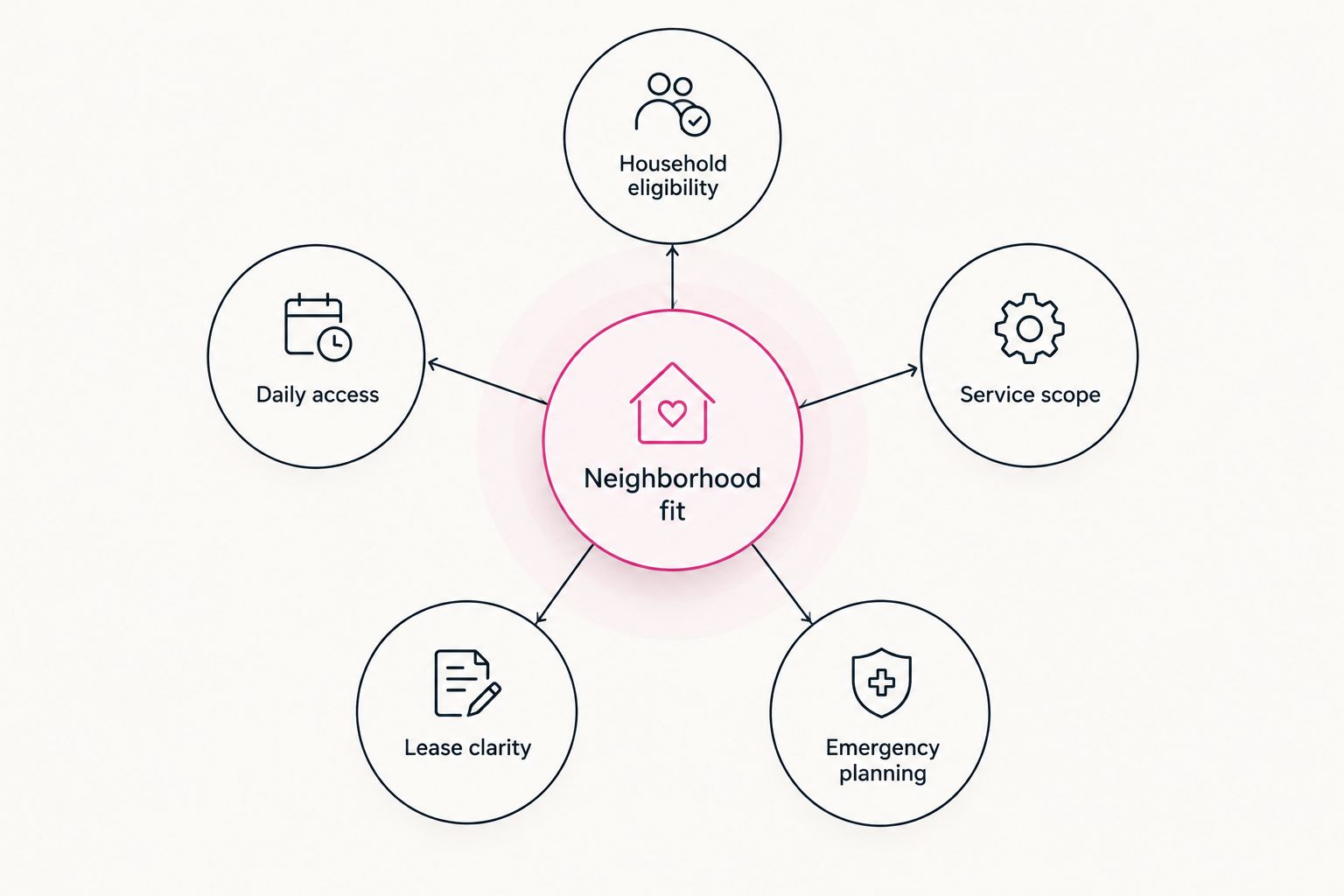
- Household eligibility: Confirm the minimum age, rules for younger household members and documentation required for every occupant.
- Daily access: Examine elevators, entrance thresholds, bathroom layout and the route between your apartment, parking and shared spaces.
- Neighborhood fit: Match the location to your actual destinations: medical appointments, groceries, family visits and regular activities.
- Service scope: Separate housing amenities from meals, transportation, housekeeping and personal care. Ask what the lease actually includes.
- Lease clarity: Review required charges, renewal terms, guest rules, parking arrangements and responsibilities for maintenance.
- Emergency planning: Ask about power interruptions, elevator outages, severe-weather communications and how residents request assistance.
Write down your nonnegotiable requirements before touring. That makes it easier to reject an attractive apartment with an unsuitable layout instead of trying to talk yourself into it.
Houston senior-apartment options at a glance
These rankings distinguish housing models, not individual properties. The best choice depends on whether you primarily need an age-qualified apartment, eligibility-based housing or services beyond the apartment itself.
| Rank and option | Best for | Standout distinction | Key limitation |
|---|---|---|---|
| 1. 55+ active-adult apartments | Independent renters seeking age-qualified housing | Apartment living within a qualifying older-adult community | The age designation does not establish care services or accessibility |
| 2. Income-restricted senior apartments | Renters whose search depends on income eligibility | Housing governed by a property's specific eligibility requirements | Age and income rules require separate confirmation |
| 3. Independent-living communities | Renters comparing housing with organized services | A housing model that can combine accommodation and defined services | The label alone does not establish what support is included |
| 4. Accessible conventional apartments | Renters prioritizing layout and location over age restrictions | A wider apartment search without requiring a senior designation | Accessibility and household rules remain property-specific |
1. 55+ active-adult apartments: best for independent renters
A 55+ active-adult apartment is the strongest starting point when you want an age-qualified community and manage your own daily routine. The designation concerns housing eligibility; it does not promise nursing care, meal service or a particular bathroom design.
For your 2026 search, ask management for the written age policy before you tour. Then compare the apartment itself, especially the entrance, shower, storage and route to parking.
55+ active-adult apartment pros:
- Focuses your search on communities with older-adult occupancy policies.
- Lets you prioritize an apartment rather than a care arrangement.
- Provides a clear starting category for comparing location and layout.
55+ active-adult apartment cons:
- A younger spouse, adult child or other household member needs a policy check.
- The senior designation does not guarantee step-free access or accessible fixtures.
- Community activities and services require individual verification.
Best for: Independent renters who specifically want an age-qualified community.
Tour the exact apartment or its matching floor plan, not just the clubhouse. Ask whether the route you inspect is the route you would actually use every day.
Verdict: Buy into this housing model as your default shortlist; commit to a building only after checking eligibility and access.
2. Income-restricted senior apartments: best for eligibility-led searches
Income-restricted senior apartments belong at the top of your research when household income determines which housing programs fit. Properties operate under different requirements, so a senior label alone is not enough to establish eligibility.
Ask which program governs the property, how household income is evaluated and what documents the application requires. Confirm the age rule separately rather than assuming every senior property follows the same threshold.
Income-restricted senior apartment pros:
- Gives you an eligibility-based path rather than an amenity-led search.
- Allows you to screen housing requirements before spending time touring.
- Creates a focused comparison of properties serving qualifying households.
Income-restricted senior apartment cons:
- Financial documentation adds work to the application process.
- Eligibility for one property does not establish eligibility elsewhere.
- A suitable income program does not guarantee a suitable apartment layout.
Best for: Renters who need to establish program eligibility before comparing homes.
Keep your household details consistent across applications. Ask management how changes in household composition or income affect qualification and any ongoing reporting requirements.
Verdict: Hold your touring schedule until the property explains its eligibility requirements; then prioritize buildings that fit both your household and daily routine.
3. Independent-living communities: best for comparing organized services
Independent living is a different decision from simply renting a 55+ apartment. You are evaluating the accommodation alongside whatever services the community expressly provides.
Start with a written service list. Ask whether meals, transportation, housekeeping or scheduled activities are included, optional or outside the arrangement; do not infer those details from the community's name.
Independent-living community pros:
- Lets you evaluate housing and organized services together.
- Creates a direct comparison around daily tasks you want help arranging.
- Provides a separate search category when an apartment-only model is insufficient.
Independent-living community cons:
- Included services differ between communities and agreements.
- Independent living is not a substitute for confirming personal-care or medical support.
- A service-focused community still needs a room-by-room accessibility check.
Best for: Independent adults who want to assess housing alongside defined daily services.
If you need help with bathing, medication or other personal tasks, state that requirement before touring. Ask who provides the assistance and under what agreement rather than assuming the housing contract covers it.
Verdict: Hold until the written service scope matches your needs; skip this model if you only want an apartment and do not need the associated services.
4. Accessible conventional apartments: best for location-first renters
A conventional apartment can be the right choice when proximity to family, medical appointments or familiar surroundings matters more than an age-qualified community. This route broadens your search beyond properties marketed to seniors.
Compare specific apartments rather than accepting a general accessibility description. Elevator access, doorway clearance, bathroom configuration and parking routes are separate questions.
Accessible conventional apartment pros:
- Broadens your neighborhood and building search.
- Supports households that do not fit a senior property's age policy.
- Lets you put physical layout ahead of a marketing category.
Accessible conventional apartment cons:
- The community does not necessarily have an older-adult occupancy policy.
- An elevator does not establish that the apartment meets your access needs.
- Resident services require the same verification as any other rental.
Best for: Renters who prioritize an appropriate home near their regular destinations.
Ask about modification requests and approval procedures before signing. If you use a mobility device, evaluate the actual routes and clearances you need rather than relying on photographs.
Verdict: Buy into this search route when location and layout matter most; skip buildings that fail your access checklist regardless of their amenities.
How the housing types are ranked
Active-adult apartments lead because they directly match an independent renter's search for age-qualified housing. Income-restricted senior apartments come next for eligibility-led searches; independent living answers a service need, while conventional apartments answer a location-and-layout need.
This ranking uses household eligibility, daily access, neighborhood fit, service scope, lease clarity and emergency planning. It does not assign property scores or imply that a named building has verified features.
Choose a Houston neighborhood around your actual routine
For a 2026 move, map your regular destinations before choosing a neighborhood. Start with the appointment address or family member's home—not a broad label such as “near the medical center.”
The Texas Medical Center, Museum District, Westchase and Memorial are useful geographic starting points for a Houston search. None establishes that a particular apartment has senior eligibility, a convenient walking route or transportation services.
Compare these practical questions:
- Medical visits: Which entrance do you use, and how will you get there?
- Groceries: Can you manage the trip and carry purchases from parking to your kitchen?
- Family contact: Does the location support the visits you actually expect?
- Outdoor access: Is the route comfortable for your mobility needs?
- Transportation: What happens when you cannot or prefer not to drive?
Make a trial trip from each finalist at the time you expect to travel. A neighborhood name is a useful search filter, not a commute guarantee.
Check the age rules before applying
Under the federal housing-for-older-persons exemption, the 55+ framework generally requires at least 80% of occupied units to have at least one occupant aged 55 years or older, along with other qualifying requirements. The federal framework also recognizes housing intended for and occupied by people aged 62 years or older.
These are federal housing categories, not permission for a younger household member to move into any senior community. The applicable provisions appear in HUD's fair-housing regulations, including 24 CFR 100.305 for the 55+ category and 24 CFR 100.303 for the 62+ category.
Request the property's written rules for your entire household. For a 2026 application, confirm the policy that applies when you apply rather than relying on an older listing or another community's rules.
Which Houston senior-apartment option should you choose?
Choose 55+ active-adult apartments first if you live independently and specifically want age-qualified housing. Switch to an income-restricted search when eligibility drives the decision, or independent living when defined services are central to your needs.
Choose accessible conventional apartments when location and physical fit outweigh the senior designation. Taco Street Locating can help you organize apartment research and neighborhood comparisons; the property must confirm its own eligibility rules and lease terms.
Before signing, collect the written household policy, service scope and lease documents. Then revisit the apartment's everyday routes. Your shortlist should survive ordinary routines, not just a pleasant tour.
FAQ
What’s the best type of 55+ apartment in Houston?
A 55+ active-adult apartment is the best starting point for an independent renter seeking age-qualified housing. Compare the household policy, apartment access and neighborhood before choosing a building.
Does everyone in a 55+ apartment have to be at least 55?
Not necessarily, but the property’s written policy determines whether your household qualifies. The federal 55+ framework includes an occupancy threshold; it does not automatically permit every younger household member.
Are 55+ apartments the same as assisted living?
No, a 55+ apartment designation does not establish personal-care or medical services. If you need assistance with daily tasks, confirm the care arrangement separately from the housing lease.
How do I qualify for income-restricted senior apartments in Houston?
You qualify by meeting the specific property’s age, income and other applicable program requirements. Ask management which program governs the property and which household documents it requires.
Can I find a senior-friendly apartment without choosing a 55+ community?
Yes, you can search conventional apartments for a suitable layout and location. Verify the exact apartment’s entrances, bathroom, parking route and elevator access rather than relying on a general accessibility description.
What should I ask about during a Houston senior-apartment tour?
Ask about household eligibility, daily access, included services, lease obligations and emergency procedures. Inspect the routes you would use between your apartment, parking and shared spaces.
Can Taco Street Locating help me compare Houston apartments?
Yes, Taco Street Locating provides a free apartment locating service that helps renters find and compare Houston apartments. Use personalized research and neighborhood guidance alongside direct property confirmation of senior eligibility and housing requirements.
One last thing
Repeat the tour as an ordinary errand. Carry a bag from the parking area, open the building doors and follow the route to the kitchen. Check where you would pause, set something down or need assistance.
That exercise reveals questions a clubhouse tour misses. The best apartment is the one that works on a regular Tuesday—not just the one that photographs well.
Related guides
- Houston apartments with in-unit washers and dryers
- Pet-friendly apartments in Houston
- Gated apartment communities in Houston
- Apartments near Rice University in Houston