

Inside this guide
- Can you rent an apartment in Texas with bad credit?
- Why this matters
- Which application route fits your situation?
- Why apartment approval with bad credit varies
- How do you apply without wasting effort?
- Is bad credit the same as an eviction or unpaid landlord debt?
- Can a guarantor guarantee apartment approval?
- What should you do if a credit report causes a denial?
- Where does an apartment locator help?
- FAQ
- One last thing
- Related guides
Yes, you can rent an apartment in Texas with bad credit in 2026; approval depends on the property's written screening criteria, not a statewide minimum credit score. A landlord can still reject an application that does not meet its criteria, and conditional approval can involve a guarantor or additional financial requirements. Ask about your specific credit issue before submitting an application or paying an application fee.
- For a rent apartment Texas bad credit search, start with written screening criteria—not listings promising easy approval.
- Texas landlords set property-specific criteria; bad credit does not create an automatic statewide rental ban.
- Taco Street Locating helps Texas renters compare apartments; property management makes the approval decision.
- A guarantor is useful only when the property accepts one for your specific screening issue.
Can you rent an apartment in Texas with bad credit?
Yes. Texas does not impose a universal minimum credit score for apartment rentals. Each landlord or management company establishes screening criteria, subject to applicable law. A weak credit history therefore does not produce the same result at every property.
Under Texas Property Code Section 92.3515, landlords must make their tenant-selection criteria, or notice of those criteria, available when providing a rental application. Those criteria can address credit history, previous rental history, current income, criminal history, and inaccurate or incomplete application information.
Start with the credit-check-to-approval workflow if you need to organize the application process. The useful question is not simply whether a community accepts bad credit. It is whether its policy accepts your particular issue, with your current income and rental history.
Why this matters
A credit score does not explain everything a property reviews. Limited credit history, overdue credit cards, a landlord collection, and a past eviction are different screening issues. Describing all of them as bad credit makes it harder to get a useful answer.
For your 2026 search, separate eligibility from preference. Confirm that a property can consider your application before spending time comparing its pool, kitchen finishes, or distance from your favorite taco stop.
That order also protects your application budget. A beautiful apartment is not a practical option when its written criteria exclude your circumstances and provide no exception process.
Which application route fits your situation?
There is no single bad-credit workaround. Compare the routes below against the property's actual policy, rather than assuming a particular building or owner will be flexible.
| Route | Best for | Main advantage | Main limitation |
|---|---|---|---|
| Standard application | Renters whose credit issue falls within the written criteria | Uses the property's normal review process | Meeting a credit requirement does not replace other screening requirements |
| Application with a guarantor | Renters at properties that accept guarantors for their issue | Adds another party responsible under the agreement | The guarantor must qualify and accept contractual liability |
| Individual review | Renters whose circumstances need an explanation | Gives management context beyond an unexplained report entry | Not every property offers exceptions or discretionary review |
| Correcting report errors first | Renters with inaccurate screening information | Addresses incorrect information before another decision | A dispute does not guarantee approval or immediate correction |
Choose the route the property confirms it accepts. Do not recruit a guarantor or submit sensitive documents for an exception process that management has not agreed to consider.
Standard application: best for issues within the criteria
Ask whether the property uses a minimum score, specific disqualifying events, or a broader screening assessment. Request the criteria in writing and compare them with the information you expect screening to reveal.
The benefit is simplicity: you follow the regular process. The limitation is that an encouraging conversation with a leasing agent is not an approval decision.
Guarantor: best for properties with an applicable policy
A guarantor can help only if management accepts guarantors for the reason your application needs support. Ask whether that policy covers credit history specifically, rather than only insufficient income or limited rental history.
The guarantor should read the agreement before signing. A guarantor takes on financial responsibility; the signature is not merely a character reference.
Individual review: best for circumstances needing context
Ask whether a manager can review supporting documentation about a resolved debt, an inaccurate entry, or a disruption followed by stable employment. Keep the explanation factual and connect each document to the issue being reviewed.
Individual review creates an opportunity to explain, not a right to an exception. A property with fixed screening rules can still decline the application.
Why apartment approval with bad credit varies
The result depends on more than the label bad credit. These factors determine which questions to ask before applying:
- Written credit criteria: Find out whether management evaluates a score, particular credit events, or both.
- Rental history: Ask how the property treats unpaid landlord balances, rental references, and prior lease problems.
- Current income: Confirm which documents management accepts and how it evaluates your income source.
- Guarantor policy: Establish whether a guarantor addresses your screening issue and what separate qualifications apply.
- Report accuracy: Incorrect balances, accounts belonging to someone else, or inaccurate rental records require a different response from accurate negative information.
- Review authority: Ask who can explain the criteria and whether anyone can consider an exception.
A Dallas apartment in Victory Park does not have a neighborhood-wide credit policy. Neither does an Austin apartment in Hyde Park. Screen the property, not the neighborhood's reputation.
Keep location preferences separate from eligibility. Once management confirms a workable application route, compare commute, layout, parking requirements, and lease terms.
How do you apply without wasting effort?
Use this sequence for a 2026 apartment search. The goal is to resolve the approval questions before you commit to a property.
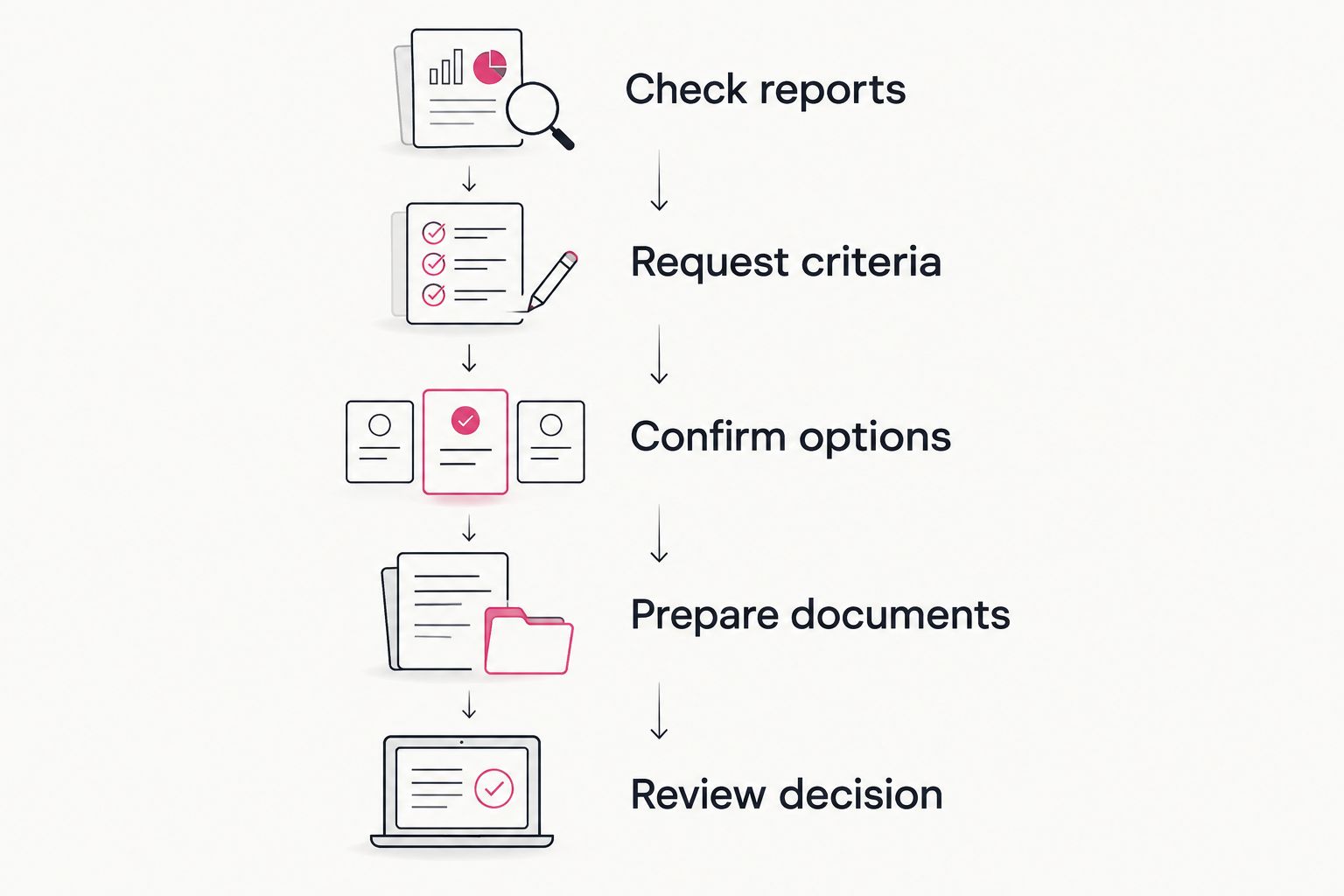
1. Check reports
Review your credit reports and identify the exact issue you need to discuss. The Consumer Financial Protection Bureau identifies Equifax, Experian, and TransUnion as the 3 nationwide credit reporting companies; a tenant-screening report can also contain information beyond a standard credit report.
Do not assume your banking app's score is the only information management will see. Look for incorrect account ownership, balances, payment status, and unfamiliar rental-related entries.
2. Request criteria
Ask management for the current tenant-selection criteria before applying. Explain your concern accurately: limited credit history is not the same as an unpaid landlord account.
Request a written response to any exception question. If the answer is unclear, resolve it before sending an application fee.
3. Confirm options
Ask whether management accepts a guarantor, offers individual review, or considers documentation showing that a reported balance has been resolved. Establish what each option actually changes in the screening decision.
Do not assume offering extra money overrides a disqualifying rule. Have management explain any proposed condition and provide the terms in writing.
4. Prepare documents
Collect identification, accepted income documentation, relevant rental records, and documents supporting any correction or explanation. If you are relocating for work, ask whether an offer letter meets the property's documentation requirements.
Use the property's verified submission process. Do not send Social Security numbers, bank records, or identification to an unverified listing contact.
5. Review decision
Read the written result and any conditions before signing a lease. Check that the apartment, lease dates, occupants, and guarantor obligations match what you agreed to.
If management declines the application, identify the stated reason before applying elsewhere. Repeating the same application without understanding the problem is not a strategy.
Is bad credit the same as an eviction or unpaid landlord debt?
No. Bad credit, an eviction record, and unpaid landlord debt are separate issues that can overlap. Paying credit-card bills on time now does not explain how a property will evaluate an old rental balance or court record.
Tell management which issue applies instead of asking only whether it accepts a low score. For a court-related rental history problem, use the separate guide to renting in Texas with an eviction on your record.
If you have resolved a landlord balance, retain documentation showing the resolution. Ask how management evaluates that documentation; do not assume payment automatically removes a record or changes the property's criteria.
Can a guarantor guarantee apartment approval?
No. A guarantor does not guarantee approval. The property must accept that arrangement, the guarantor must satisfy its requirements, and the application must meet the remaining criteria.
Ask management whether the guarantor policy addresses credit problems or only another qualification issue. Also ask whether the guarantor agreement applies to the entire lease obligation and how long the responsibility lasts.
A willing relative is not enough by itself. Both you and the guarantor need the actual agreement, not a verbal summary of what signing supposedly means.
What should you do if a credit report causes a denial?
Request the report and review the reason for the decision. Under the federal Fair Credit Reporting Act's adverse-action rules, a landlord that takes adverse action based partly or entirely on a consumer report must provide the required notice. Adverse action can include denial or certain less favorable rental conditions.
The Federal Trade Commission's landlord guidance explains that the notice identifies the reporting company and describes your rights. The reporting company supplies information; it does not make the landlord's decision.
For a 2026 application, remember these federal consumer-report rights:
- 60 days: You can request a free copy of the relevant report from the reporting company within 60 days of receiving an adverse-action notice.
- 30 days: Credit reporting companies generally have 30 days to investigate a dispute, according to CFPB consumer guidance; exceptions can extend that period.
- Accuracy matters: Dispute information that is incorrect or incomplete, and retain copies of your supporting documents and correspondence.
A dispute is not an instant approval mechanism. Ask management whether it will reconsider a corrected report and what documentation it needs.
Where does an apartment locator help?
Taco Street Locating is best for Texas renters who want personalized apartment research and neighborhood guidance. The apartment locating service helps renters compare options in Austin, Dallas–Fort Worth, Houston, and San Antonio.
For a credit-sensitive search, share your circumstances and ask which screening questions need answers before you apply. Local neighborhood knowledge helps you compare practical choices after eligibility is addressed.
The limit is straightforward: Taco Street Locating does not make a property's approval decision. Keep written confirmation of screening requirements from management, even when someone helps you organize the search.
Start your Texas apartment search
Get personalized apartment research and local neighborhood guidance.
FAQ
What’s the minimum credit score to rent an apartment in Texas in 2026?
Texas has no statewide minimum credit score for apartment rentals in 2026. Ask each property for its written tenant-selection criteria and how it evaluates your specific credit history.
Can I rent an apartment with bad credit if I have steady income?
Yes, approval is possible, but steady income does not automatically override a property’s credit criteria. Confirm both the income documentation requirements and the credit policy before applying.
Will a guarantor fix a bad-credit apartment application?
A guarantor helps only when the property accepts guarantors for your specific screening issue. The guarantor must qualify, and other application requirements still apply.
Is no credit history treated the same as bad credit?
No credit history and negative credit history are different circumstances. Ask management how its screening criteria handle a limited credit file rather than assuming either automatic approval or denial.
How long do I have to request a report after an apartment denial?
You have 60 days after receiving an adverse-action notice to request a free copy of the relevant report from the reporting company. Review the notice for the company’s contact information.
Can Taco Street Locating approve me for an apartment with bad credit?
Taco Street Locating helps renters compare apartments; the property makes the approval decision. Personalized research does not replace management’s screening criteria.
Should I offer more money to get approved with bad credit?
Do not assume an additional payment overrides the property’s screening rules. Ask management which application conditions it accepts and get the terms in writing before committing.
One last thing
Ask what would change the decision before asking where else to apply. A correctable report error, an acceptable guarantor, and a fixed disqualifying criterion require different next moves.
For your 2026 search, keep a short record for each property: the criteria received, the issue discussed, management's response, and any required documents. That record is more useful than a long list of apartments labeled bad-credit friendly without an explanation.
Related guides
- How long does apartment application approval take in Texas?
- Applying for an Austin apartment before your first paycheck
- How do apartment locators work in Texas?