

Inside this guide
- Is Fort Worth cheaper to rent in than Dallas in 2026?
- Why this matters
- Compare neighborhoods before comparing city names
- How to build a fair Dallas–Fort Worth rent comparison
- What belongs in your total housing cost?
- Why the Dallas–Fort Worth comparison varies
- Does a lower advertised rent mean a cheaper apartment?
- Should you live in Fort Worth and commute to Dallas?
- Is a smaller Dallas apartment a better comparison?
- When personalized apartment help makes sense
- FAQ
- One last thing
- Related guides
Fort Worth is not automatically cheaper to rent in than Dallas in 2026; the answer depends on the apartments, lease terms, and commute you compare. A lower advertised rent does not establish a lower total housing cost because required fees, parking, utilities, and transportation belong in the calculation. Choose the apartment with the lower workable total, not the city with the cheaper reputation.
- Is Fort Worth cheaper than Dallas to rent? Compare matched apartments and total costs before choosing a city.
- Taco Street Locating helps renters compare Dallas–Fort Worth apartments through personalized research and local neighborhood knowledge.
- Match bedroom count, lease length, move-in date, and required amenities before comparing apartment quotes.
- Include required fees, parking, utilities, and your actual commute in the decision.
Is Fort Worth cheaper to rent in than Dallas in 2026?
Fort Worth is cheaper for your search only if a suitable Fort Worth apartment has a lower total cost than a suitable Dallas alternative. Comparing an older apartment outside central Fort Worth with a newer apartment in Dallas’s Victory Park does not isolate a city-level difference. It compares different locations and properties.
Start with matched requirements, then compare written quotes. Taco Street Locating offers free apartment locating for renters comparing Dallas–Fort Worth apartments, with personalized research and neighborhood guidance.
| Search approach | Best for | Advantage | Limitation |
|---|---|---|---|
| Fort Worth-focused search | Renters whose regular destinations are in Fort Worth | Keeps neighborhood research centered on the places you use | Does not establish savings over a comparable Dallas apartment |
| Dallas-focused search | Renters whose regular destinations are in Dallas | Lets you prioritize access to Dallas destinations | Does not establish that every Dallas neighborhood fits your budget |
| Both-city search | Renters with location flexibility | Tests actual apartment alternatives rather than city reputations | Requires separate commute checks and matched quotes |
These are search strategies, not rent rankings. Your employer’s address, household needs, and lease requirements decide which strategy deserves your time.
Why this matters
A citywide rent figure answers a different question from the one you face: which apartment should you lease? Even a properly sourced average does not tell you the charges, condition, or transportation demands of a particular home.
For a 2026 move, keep the decision grounded in apartments you would actually accept. Rejecting an unsuitable floor plan is not overlooking a bargain. It is keeping the comparison honest.
A useful shortlist also protects your attention. You do not need to tour every apartment in both cities; you need enough comparable choices to understand the trade-offs.
Compare neighborhoods before comparing city names
Dallas and Fort Worth each contain distinct neighborhoods. Use those neighborhoods to organize your search, not as shorthand for a guaranteed price level.
Fort Worth: best for a Fort Worth-centered routine
Start with Downtown Fort Worth, the Near Southside, and the Cultural District if those areas fit your destinations. Map your workplace, grocery stops, and regular activities before deciding which neighborhood to investigate.
The advantage is a search built around your actual routine. The limitation is that choosing Fort Worth does not settle the apartment question: building condition, layout, parking, and lease terms still need inspection.
On a tour, distinguish the neighborhood experience from the specific unit. A convenient district does not tell you whether your bedroom faces a busy street or whether the parking arrangement works for you.
Dallas: best for a Dallas-centered routine
Use Uptown, Victory Park, Trinity Groves, and other relevant Dallas neighborhoods as separate search areas. Check the exact apartment address against your destinations rather than treating “Dallas” as one commute.
The advantage is keeping your search close to the Dallas places you use. The limitation is the same: a neighborhood name does not establish an apartment’s total cost or suitability.
For example, investigate the route from a Trinity Groves apartment to your workplace independently from a Victory Park apartment. Do not transfer assumptions about one address to another.
Both cities: best for renters with genuine location flexibility
If you work remotely or have destinations across the metroplex, test both cities against the same requirements. Keep internet needs, workspace, parking, and household routines on the checklist.
The advantage is a wider set of alternatives. The drawback is comparison work: a flexible location does not remove the need to check each property’s terms and surroundings.
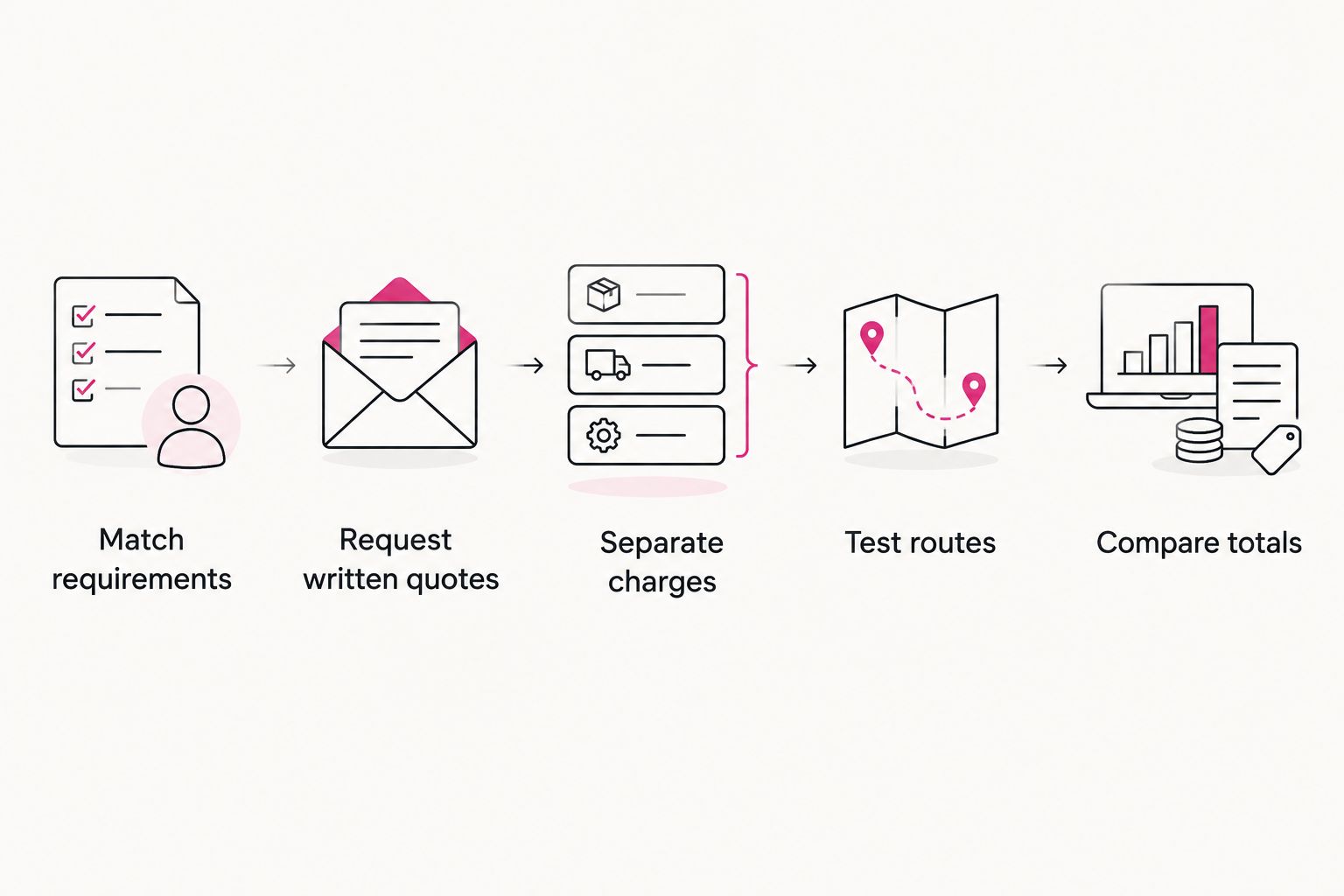
How to build a fair Dallas–Fort Worth rent comparison
Use this process for your 2026 shortlist. The goal is a decision sheet, not a collection of attractive listing screenshots.
- Match requirements. Fix your bedroom count, essential accessibility needs, pet requirements, and acceptable floor plans. Separate necessities from preferences so you do not quietly change standards between cities.
- Request written quotes. Ask each property for the exact apartment, intended move-in date, lease length, and itemized charges. Record the date of each quote so you know what needs reconfirmation.
- Separate charges. Put recurring obligations in one section and upfront payments in another. Identify which upfront amounts are refundable rather than treating every payment as an expense you permanently lose.
- Test routes. Check your actual workplace entrance, work schedule, and regular errands. Include parking and any transit connections you expect to use.
- Compare totals. Review the full lease commitment alongside monthly cash flow. Eliminate apartments that fail a nonnegotiable requirement before choosing the lower-cost remaining option.
Build a working shortlist of 3 apartments per city. That is a practical research target, not a claim that every renter needs the same number of tours.
Keep the comparison period consistent. A 12-month comparison is useful when both quotes cover that lease length; otherwise, compare the actual lease commitments and separately check the monthly obligations. Do not multiply unlike quotes and call the results equivalent.
What belongs in your total housing cost?
Base rent is one line, not the final answer. Ask the leasing office to identify every required charge and distinguish optional services from lease obligations.
| Cost category | What to request | Comparison mistake to avoid |
|---|---|---|
| Base rent | Written amount for the exact unit and lease term | Using a general listing instead of the unit quote |
| Required recurring charges | Itemized services and mandatory fees | Assuming the headline rent includes them |
| Parking | Terms for the parking arrangement you need | Comparing different parking arrangements as equivalent |
| Utilities | Responsibility for each service and billing method | Treating unlike utility arrangements as identical |
| Pet-related charges | Written terms for your specific pets | Assuming pet acceptance means no additional obligations |
| Upfront payments | Itemized charges and refund conditions | Mixing refundable deposits with nonrefundable expenses |
| Transportation | Your route, parking needs, and travel expenses | Ignoring the cost of reaching work |
For pet owners, the guide to pet deposits for Texas apartments explains another part of the comparison. Confirm the property’s written pet terms before applying.
Keep affordability and qualification separate, too. Your personal budget answers whether the apartment works for you; the property’s screening criteria answer whether your application meets its requirements. Ask for both before paying application-related charges.
Why the Dallas–Fort Worth comparison varies
These factors change what you are comparing. None establishes a universal winner between the cities.
- Exact location: Compare specific addresses against your destinations. A city boundary is not a measure of convenience.
- Apartment characteristics: Match bedroom count, usable space, condition, and essential features. A different apartment type is a different purchase decision.
- Lease term and start date: Request quotes for the term and move-in date you intend to use. Do not assume another lease configuration has identical terms.
- Required charges: Compare itemized obligations, including applicable parking and pet charges. Optional features belong in your total only if you intend to select them.
- Transportation needs: Include your actual route, vehicle needs, and parking arrangements. Evaluate the routine you will follow, not a best-case map preview.
- Written offer conditions: If a property presents an incentive, request its conditions and payment schedule. Do not treat an old advertisement as a current lease offer.
For your 2026 decision, use the same checklist in both cities. Consistent questions expose differences more clearly than a longer list of unrelated properties.
Does a lower advertised rent mean a cheaper apartment?
A lower advertised rent does not establish a cheaper apartment. Required charges and the lease’s payment schedule determine what you must pay beyond the headline amount.
Ask for both the regular monthly obligation and any differently scheduled payments. If an offer changes when payments are due, confirm the schedule rather than assuming every month has the same obligation.
Should you live in Fort Worth and commute to Dallas?
Choose a Fort Worth apartment for a Dallas job only after testing the actual route. Compare the workplace address, required arrival time, parking arrangement, and return trip before deciding that the housing trade-off works.
There is no useful universal commute estimate for every Dallas–Fort Worth renter. Your apartment and workplace addresses matter more than a city-to-city label.
Is a smaller Dallas apartment a better comparison?
A smaller Dallas apartment belongs on your shortlist if the layout still meets your needs. It is not a like-for-like size comparison, so record the space you are giving up and the convenience you expect in return.
Measure essential furniture and check storage during the tour. A workable smaller home is a legitimate alternative; an unusable floor plan is not a saving.
When personalized apartment help makes sense
Taco Street Locating is best for renters who want personalized help comparing Dallas–Fort Worth apartments. Its free apartment locating service combines personalized apartment research with local neighborhood knowledge.
The benefit is help organizing the search around your requirements. The limitation is that personalized guidance does not replace your review of the unit, screening criteria, written quote, or lease.
Bring a clear brief: workplace address, move-in window, household needs, pets, parking requirements, and nonnegotiable features. Ask for the trade-off behind each suggestion, not just another list of buildings.
Compare Dallas and Fort Worth apartments
Get personalized apartment research and neighborhood guidance for your Dallas–Fort Worth move.
FAQ
Is Fort Worth cheaper than Dallas to rent in 2026?
Fort Worth is cheaper for your search only when a suitable Fort Worth apartment has a lower total cost than a suitable Dallas alternative. Match apartment requirements, written lease terms, required charges, and transportation needs before deciding.
Should I compare average rents or actual apartment quotes?
Use actual apartment quotes to choose a home. Citywide averages provide context, but they do not establish the terms or total cost of the apartment you would lease.
Which Dallas and Fort Worth neighborhoods should I compare?
Compare neighborhoods that fit your regular destinations. Starting areas include Downtown Fort Worth, the Near Southside, and the Cultural District in Fort Worth, plus Uptown, Victory Park, and Trinity Groves in Dallas; none is a guaranteed cheaper choice.
How many apartments should I compare in each city?
Start with 3 apartments per city as a manageable research target. Keep requirements consistent and expand the shortlist if the initial options do not meet your needs.
Does lower rent justify commuting from Fort Worth to Dallas?
Lower rent alone does not justify the commute. Test the actual route and include transportation expenses, parking, and the effect of the trip on your routine.
What should I ask before applying for an apartment?
Request the exact unit quote, itemized charges, screening criteria, and payment conditions before applying. Confirm that the quoted lease term and move-in date match your plans.
Can Taco Street Locating help me compare both cities?
Taco Street Locating helps renters compare and find apartments in Dallas–Fort Worth through its free apartment locating service. Share your destinations, household requirements, and move-in plans to focus the research.
One last thing
Before signing a lease in 2026, take your finalist’s address through an ordinary day: leave for work, return home, park, bring in groceries, and picture where you will work or sleep. Check these details during a visit wherever possible.
The useful question is not which city sounds cheaper, but which suitable apartment leaves you with the better total commitment. Settle that with matched quotes and a tested routine. Save the taco debate for after the apartment decision.
Related guides