
Inside this guide
- Why this matters
- How much does a pet deposit cost for apartments in Texas?
- Refundable pet deposits: money held against lease obligations
- Nonrefundable pet fees: a different budget category
- Monthly pet rent: compare the whole lease term
- Why pet-related apartment costs vary
- How do you get a reliable pet-cost quote before applying?
- How should you compare Austin, Dallas–Fort Worth, and Houston apartments?
- Can a Texas apartment keep your pet deposit?
- Do you pay pet charges for an assistance animal?
- FAQ
- One last thing
- Related guides
The pet deposit cost for Texas apartments depends on the property’s written pet policy; there is no single statewide amount for 2026. A refundable deposit is only part of your budget because a separate nonrefundable pet fee, recurring pet rent, and damage charges can also apply under the lease.
- Pet deposit cost for Texas apartments depends on the lease, not a statewide standard amount.
- Separate refundable pet deposits, nonrefundable pet fees, and recurring pet rent before comparing apartments.
- Taco Street Locating helps Texas renters compare apartments; confirm pet charges directly with each property.
- Get written approval for your specific animal before paying an application fee.
Why this matters
An apartment described as pet-friendly is not automatically a fit for your animal or your move-in budget. You need to know whether the property accepts your pet, what you must pay before receiving keys, and which charges continue during the lease.
Start with your complete Texas apartment move-in budget, then separate the pet-related portion. A refundable deposit affects your cash needed upfront; a nonrefundable fee affects what you permanently spend. Treating them as interchangeable makes apartment comparisons misleading.
How much does a pet deposit cost for apartments in Texas?
Texas does not establish a standard pet deposit that every apartment must charge. For a 2026 apartment search, the useful figure is the amount on the property’s current written fee schedule and pet addendum—not a statewide estimate or an old listing.
Ask the leasing office to identify each charge separately. The following table explains what you are comparing, rather than presenting unsupported market averages.
| Charge | What it means | Useful feature | Budget drawback |
|---|---|---|---|
| Refundable pet deposit | Money held as security for obligations covered by the agreement | An unused balance is potentially refundable | You need the money upfront, and lawful deductions can reduce the refund |
| Nonrefundable pet fee | A charge the agreement identifies as nonrefundable | You can identify the permanent expense before signing | You should not expect it back at move-out |
| Pet rent | A recurring charge for keeping an approved pet | You can calculate its effect over your lease term | It adds to your recurring housing payment |
| Damage charge | A charge for damage for which you are responsible | Documentation lets you check what is being claimed | Paying a deposit or fee does not necessarily eliminate further liability |
For a 12-month lease, calculate recurring pet rent across 12 monthly payments. Keep that total separate from the refundable deposit so you can see both the cash required to move in and the nonrefundable expense of keeping your pet there.
Refundable pet deposits: money held against lease obligations
A refundable pet deposit is not a guaranteed refund. The agreement determines what it secures, and applicable Texas security-deposit rules govern money that qualifies as a security deposit.
Texas Property Code Section 92.102 defines a security deposit by its purpose, not simply by the label on a receipt. Read the pet addendum alongside the main lease, especially when one document uses “deposit” and another uses “fee.”
Ask these questions before paying:
- Is the entire amount refundable, or is part explicitly nonrefundable?
- Is the amount charged per animal or per apartment?
- Does the agreement describe permitted deductions?
- Where will the payment appear on your resident ledger?
Best for comparing upfront cash: the refundable deposit line tells you how much money is tied up at move-in. Its limitation is timing: even money ultimately returned is unavailable while the landlord holds it.
Nonrefundable pet fees: a different budget category
A nonrefundable pet fee is not money you should plan to recover when you leave. Get the designation in writing rather than relying on a leasing conversation or a payment portal’s abbreviated label.
The useful feature is clarity: a clearly disclosed fee is an expense you can include in your decision before signing. The drawback is equally clear—you do not recover it merely because your pet causes no damage.
Best for comparing permanent move-in expenses: list nonrefundable pet fees beside other nonrefundable charges. Do not subtract them from a future damage bill unless your agreement actually provides that credit.
Also ask what the fee covers. A pet fee is not automatically a cleaning service, damage waiver, insurance policy, or substitute for permission to keep an animal.
Monthly pet rent: compare the whole lease term
Monthly pet rent changes the recurring cost of an apartment. Comparing only the deposit leaves out that continuing obligation.
For your 2026 shortlist, record the recurring charge, whether it applies per animal, and when billing starts. If you are comparing different lease lengths, calculate each apartment over the term you would actually sign instead of comparing one monthly line in isolation.
Best for comparing ongoing affordability: recurring pet rent belongs in your monthly housing budget. Its drawback is accumulation: a smaller upfront deposit does not establish that an apartment has the lower total nonrefundable expense.
Keep your worksheet simple:
- Refundable pet deposit: cash needed upfront.
- Nonrefundable pet fee: permanent upfront expense.
- Pet rent multiplied by lease months: recurring expense over the term.
- Potential damage charges: a separate liability, not a predictable quoted expense.
Why pet-related apartment costs vary
The written policy matters more than a citywide label. Two apartments in the same neighborhood can structure pet charges differently, so an Austin, Dallas–Fort Worth, or Houston search still requires property-by-property confirmation.
These are the policy details to check:
- Charge structure: Determine whether the apartment uses a refundable deposit, a nonrefundable fee, recurring pet rent, or a combination.
- Per-pet rules: Confirm whether the quoted amount covers your household or each approved animal.
- Pet eligibility: Ask about species, breed, weight, and animal-count rules before comparing the financial terms.
- Lease duration: Recurring charges accumulate over the months you agree to rent.
- Refund conditions: Read the clauses explaining deductions, cleaning responsibilities, and move-out obligations.
Do not assume a dog park means fewer restrictions or lower charges. Amenities describe the property; the pet addendum establishes the terms for your animal.
How do you get a reliable pet-cost quote before applying?
Use the same process for every apartment on your 2026 shortlist. Consistent questions make differences visible without relying on an unsupported “typical” deposit.
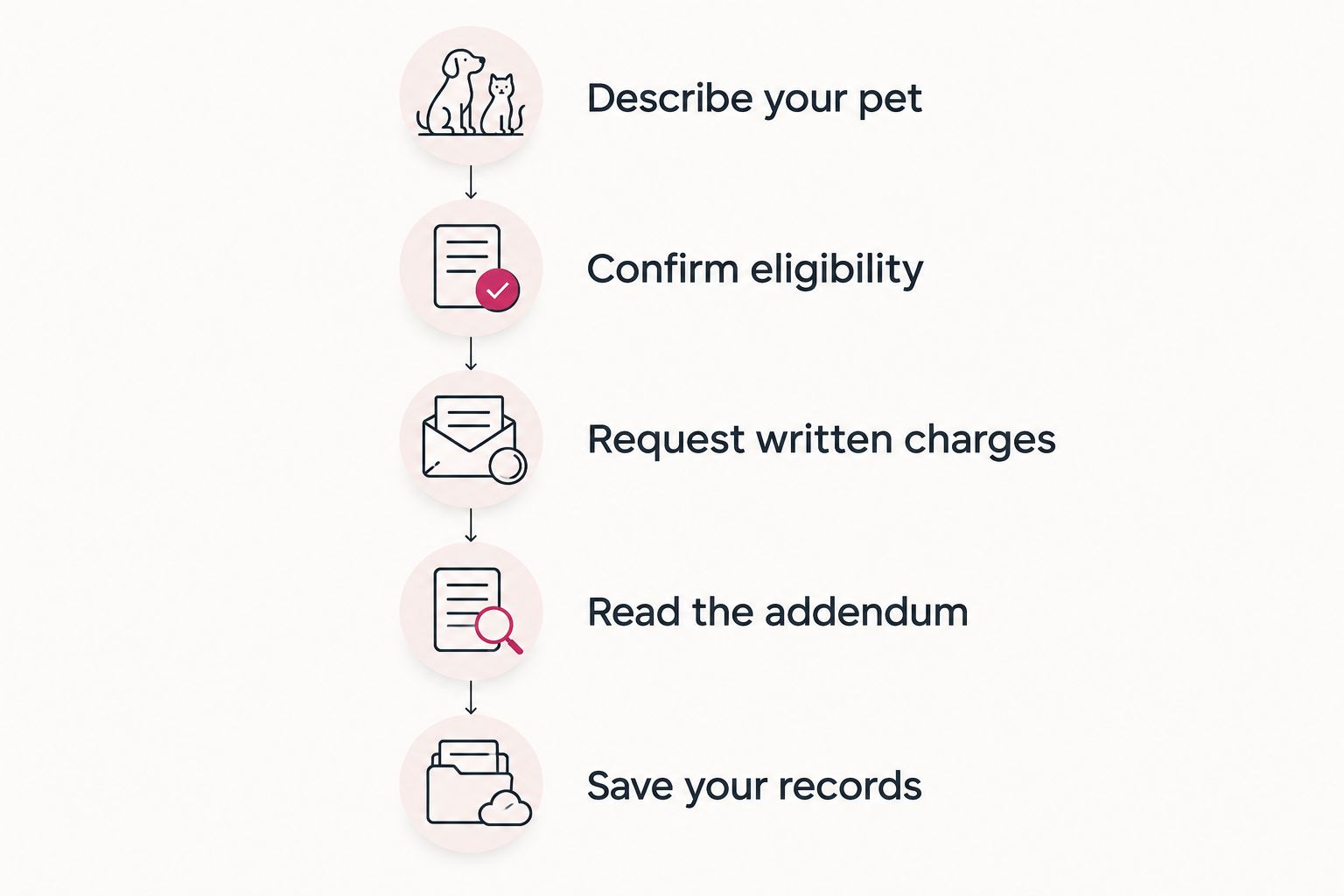
- Describe your pet. Give the leasing office the species, breed or mix if known, weight, and number of animals. Ask what supporting records it requires.
- Confirm eligibility. Request written confirmation that your animal meets the property’s policy. Do this before spending money on an application.
- Request written charges. Ask for separate lines identifying the deposit, fee, recurring pet rent, and any other required pet-related service.
- Read the addendum. Compare the quote with the document you will sign. Resolve conflicting labels or amounts before payment.
- Save your records. Keep the written approval, signed addendum, receipts, and move-in condition report together.
If a quote says only “pet charge,” ask the office to clarify it. You need the refund status, billing frequency, and basis for the charge—not just a total.
How should you compare Austin, Dallas–Fort Worth, and Houston apartments?
Choose the location around your daily routine, then compare the pet terms within that shortlist. Neighborhood names do not establish a pet policy: an apartment in Hyde Park, Trinity Groves, or Victory Park still needs its own written review.
For an Austin relocation, consider the route you will use to take your dog outside, where you will walk after dark, and how the commute fits your schedule. For Dallas–Fort Worth and Houston, apply the same checks rather than choosing solely from amenity photos.
On a tour, look at the actual route from the available unit to the exit. A dog run is less useful to your routine if reaching it requires a trip you do not want to repeat throughout the day.
Taco Street Locating is a free apartment locating service for renters comparing apartments in Austin, Dallas–Fort Worth, and Houston. Personalized apartment research and local neighborhood knowledge help shape your shortlist; the property’s written approval and lease remain the authority on pet acceptance and charges.
Use Taco Street Locating for apartment-search help, not as a substitute for reading the pet addendum. Ask the leasing office to resolve any conflict between a listing, a conversation, and the final agreement.
Can a Texas apartment keep your pet deposit?
A landlord can make lawful deductions from a security deposit for damages and charges for which the tenant is legally liable under the lease. Texas Property Code Section 92.104 excludes normal wear and tear from security-deposit deductions.
For a 2026 move-out, document condition rather than assuming every cleaning or flooring charge is valid. Photograph the apartment at move-in and move-out, keep your condition report, and request the written explanation for deductions when required by law.
Texas Property Code Section 92.103 generally requires refunding a security deposit on or before 30 days after surrender of the premises. Section 92.107 also requires the tenant to provide a written forwarding address before the landlord’s obligation to refund or itemize becomes due; lease notice provisions also deserve attention.
These rules concern security deposits, not an automatic refund of a charge properly treated as a nonrefundable fee. A disputed classification or deduction calls for lease-specific legal guidance.
Do you pay pet charges for an assistance animal?
An assistance animal is not treated as an ordinary pet under federal fair-housing reasonable-accommodation rules. HUD’s assistance-animal guidance explains that housing providers cannot charge a pet deposit or pet fee for an approved assistance animal as a condition of the accommodation.
That does not remove responsibility for animal-caused damage. Follow the property’s accommodation process and consult HUD’s Fair Housing Act guidance when you need to understand documentation or a disputed request.
For a 2026 application, explain that you are requesting an assistance-animal accommodation rather than simply asking about the standard pet package. Do not buy an online certificate on the assumption that it automatically establishes your rights.
FAQ
What is the average pet deposit cost for Texas apartments?
There is no statewide standard pet deposit, and a reliable average requires current property-level data. Get the apartment’s written deposit amount and separate it from nonrefundable fees and recurring pet rent.
Is a pet deposit refundable in Texas?
A refundable pet deposit is potentially returnable, subject to lawful deductions and the agreement. A nonrefundable pet fee is a different charge, so confirm the classification before paying.
Can an apartment charge both a pet deposit and pet rent?
An apartment’s agreement can include both a pet deposit and recurring pet rent. Ask for each charge separately and confirm whether it applies per animal or per household.
Does paying a pet fee cover all damage my dog causes?
Paying a pet fee does not automatically cover all damage your dog causes. Read the lease for your damage responsibilities and any express credit or waiver.
How long does a Texas landlord have to return a pet deposit?
For money qualifying as a security deposit, Texas law generally requires a refund on or before 30 days after surrender. Provide a written forwarding address and check applicable lease notice requirements.
Do emotional support animals have to pay pet deposits?
An approved assistance animal is not subject to a pet deposit or pet fee under federal fair-housing accommodation rules. The resident can still be responsible for damage caused by the animal.
Can Taco Street Locating help me find a pet-friendly apartment?
Taco Street Locating helps renters find and compare apartments in Austin, Dallas–Fort Worth, and Houston. Share your animal’s details early, then confirm acceptance and all pet charges directly with the property before applying.
One last thing
A written pet approval is more useful than a pet-friendly badge on a listing. Before you apply, ask the leasing office to confirm your specific animal’s eligibility, every required charge, and which money is refundable.
Keep that response with your signed documents. A clear record helps you check the first resident statement and gives you something concrete to reference if the billing differs from the agreement.
Related guides
- Best Apartments With Dog Parks in Dallas
- Best Pet-Friendly Apartments in Houston
- How Much Does Renters Insurance Cost for a Texas Apartment?
- How Do Apartment Locators Work in Texas?