

Inside this guide
- How much more do luxury apartments cost than standard apartments in Dallas?
- Why this matters
- Compare total lease costs before comparing amenities
- Luxury apartments: best for upgrades you will actually use
- Standard apartments: best for essential needs without extra requirements
- Why the luxury-versus-standard difference varies
- How should you compare Dallas neighborhoods?
- What should you ask during a luxury-versus-standard tour?
- Is a luxury apartment worth the extra commitment?
- Can a standard apartment have the features you want?
- How can an apartment locator help you compare?
- FAQ
- One last thing
- Related guides
Luxury apartments in Dallas have no fixed premium over standard apartments: your cost difference depends on the specific units, lease terms, and required fees you compare. For a useful 2026 comparison, subtract the standard apartment’s total lease cost from the luxury apartment’s total lease cost—not just their advertised rents. Keep refundable deposits separate, because they affect move-in cash without necessarily becoming a permanent expense.
- For luxury apartments vs standard apartments cost Dallas comparisons, use matched units and total lease costs—not labels.
- Luxury is best for renters who will use the specific upgrades; standard apartments suit renters prioritizing essentials.
- Required fees, parking, utilities, and lease terms belong in your comparison.
- Taco Street Locating offers free apartment locating for Dallas renters who want help comparing their options.
How much more do luxury apartments cost than standard apartments in Dallas?
The answer is the difference between two written, unit-specific quotes over the same period. A luxury label alone cannot tell you the premium, what it includes, or whether it fits your priorities.
For personalized apartment research, Taco Street Locating helps renters compare Dallas apartments. Start with your commute, move-in date, budget, and nonnegotiables rather than a luxury-only search.
Use this table to compare the categories without assuming every property offers the same features.
| Comparison point | Luxury apartment | Standard apartment |
|---|---|---|
| Best for | Renters who will use verified upgrades and shared amenities | Renters who prioritize essential features and their total budget |
| Potential advantage | The specific unit or community includes upgrades you value | You can focus on location, layout, and essentials without requiring an amenity package |
| Main drawback to check | Whether you would pay extra for features you rarely use | Whether missing features create separate expenses or inconvenience |
| Interior review | Verify finishes, appliances, storage, and the actual floor plan | Verify the same details; the category does not establish condition |
| Shared amenities | Check access rules, operating hours, and any separate charges | Confirm what exists rather than assuming there are no amenities |
| Financial test | Identify exactly what the additional commitment buys | Identify exactly what you give up, if anything |
Neither category guarantees maintenance quality, quiet neighbors, useful storage, or a convenient commute. Those require their own checks.
Why this matters
A Dallas apartment comparison becomes misleading when several things change at once. Comparing a larger apartment in Victory Park with a smaller apartment in another neighborhood measures more than the difference between luxury and standard housing.
Your 2026 shortlist should separate location, usable space, and building features. Otherwise, you cannot tell whether an apparent premium buys a better daily routine or simply a different address and floor plan.
The practical goal is not to prove that luxury is expensive or that standard is economical. It is to identify the apartment that meets your needs without adding commitments you do not value.
Compare total lease costs before comparing amenities
Build the comparison from written quotes for actual units. A community’s general advertising is not a substitute for the terms attached to the apartment you would lease.
Match the units
Compare the same bedroom count, reasonably similar usable space, and the same intended move-in date. Record differences in bathrooms, storage, outdoor space, and work-from-home layout instead of treating them as equivalent.
For example, a separate workspace and a desk squeezed beside the bed are different living arrangements. Decide whether that distinction matters before judging the apartment by its category.
Match the terms
Use the same lease length wherever possible. A 12-month lease and a 6-month lease represent different commitments, so their monthly figures alone do not create a clean comparison.
If the terms differ, write that difference beside the quote. Do not mistake flexibility for an interior upgrade or assume a shorter commitment represents better value.
Collect the charges
Ask each leasing office for an itemized statement of required recurring charges and nonrefundable move-in charges. Ask separately about parking, pets, utilities, insurance requirements, and services bundled into the lease.
Mark each charge as required, optional, or dependent on your circumstances. An optional parking arrangement should not silently enter one apartment’s total while disappearing from the other.
Compare the commitment
Total lease cost equals scheduled rent plus required recurring charges and nonrefundable charges, less any written credit that applies to your lease. Keep refundable deposits outside that expense total and inside your move-in cash plan.
Then subtract the standard apartment’s total from the luxury apartment’s total. To express the result monthly, divide the difference by the number of months in the matched lease period.
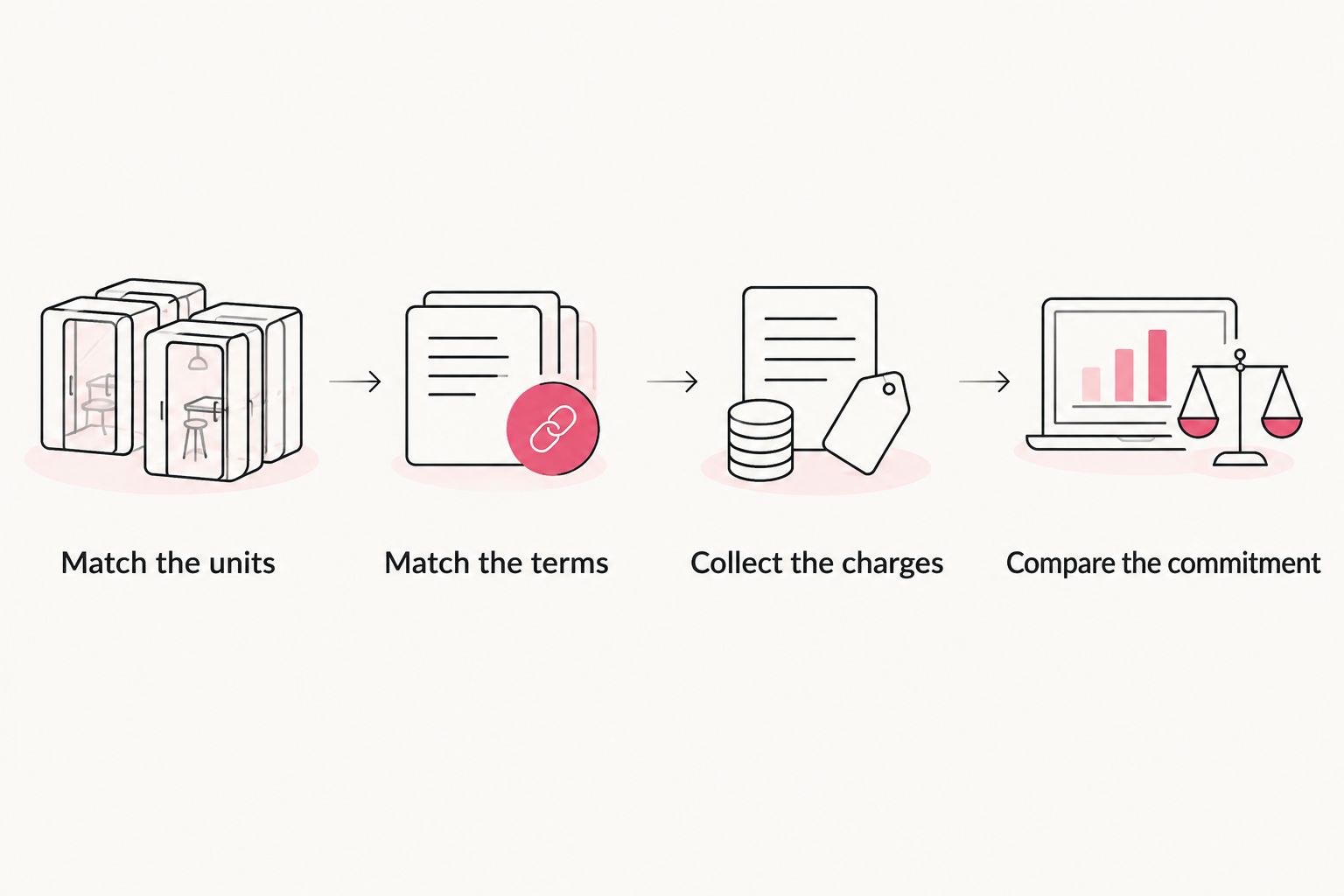
Keep the comparison sheet simple enough to update after a tour. Its job is to make differences visible, not turn your apartment search into a second job.
Luxury apartments: best for upgrades you will actually use
A luxury apartment deserves a place on your shortlist when the specific unit or building solves a real need. That could mean a useful workspace, a preferred layout, or an amenity that fits your routine—but verify each feature at the property.
Choose the upgrade for its function, not its label. A fitness center matters differently to someone who will use it regularly than to someone who already prefers an outside gym.
The drawback is paying for an appealing package without getting enough practical use from it. During the tour, ask about access, restrictions, and whether the amenity you want is included in your lease.
For your 2026 decision, write a short explanation beside each upgrade: what it does for you, what it replaces, and whether you would still want it after the initial excitement fades.
Standard apartments: best for essential needs without extra requirements
A standard apartment belongs on your shortlist when it meets your layout, location, and daily-living requirements. Do not reject a suitable unit because its listing uses less polished language.
The advantage is a more focused decision: does this apartment do what you need? The drawback is that a missing feature can create an outside expense or recurring inconvenience.
Check laundry arrangements, parking, storage, and your workspace before calling a unit the simpler choice. A feature you consider essential does not stop being essential because the apartment is presented as budget-friendly.
Choose standard when the apartment meets your needs without a meaningful compromise. Inspect condition and management practices separately; neither follows automatically from the category.
Why the luxury-versus-standard difference varies
These factors belong on your comparison sheet because they change what you are comparing or what you must pay for:
- Location: Keep neighborhood and commute differences visible. An apartment in Trinity Groves and one in Victory Park are different location choices, not just different finish packages.
- Floor plan and usable space: Record bedroom count, bathrooms, storage, and whether the layout supports your household. Extra space and better-used space are not interchangeable.
- Lease terms: Match the lease length and move-in date. Document any written conditions attached to the quote.
- Required services: Ask which recurring charges are mandatory and which you can decline. Compare the full obligation rather than the headline rent alone.
- Parking and pets: Compare arrangements that fit your actual household. Confirm pet-related requirements and parking terms for each property.
- Features you would otherwise obtain elsewhere: Check whether an included feature genuinely replaces something you use. Do not count an imaginary saving for an expense you never had.
These are comparison factors, not evidence that every luxury apartment charges more for each item. Let the written quote establish the difference.
How should you compare Dallas neighborhoods?
Start with the places you need to reach. If your routine centers on an office, campus, or family address, compare actual routes from each building rather than treating the neighborhood name as the whole answer.
For a 2026 search involving Uptown, Victory Park, or Trinity Groves, tour the immediate surroundings as well as the apartment. Look at the building entrance, parking access, nearby construction, and the route you would use for everyday errands.
Ask yourself what you would trade for the location. A preferred neighborhood does not automatically make an awkward floor plan workable, and an attractive interior does not shorten a route you dislike.
Compare within a neighborhood first, then compare across neighborhoods. This helps you separate the value of the address from the value of the building’s features.
What should you ask during a luxury-versus-standard tour?
Use the same questions at every property. Consistency prevents a memorable amenity tour from overshadowing the details that affect your actual apartment.
- Which unit am I evaluating? Ask whether you are seeing the apartment you would lease or a model with different features.
- What is required beyond rent? Request the itemized recurring charges and the nonrefundable move-in charges in writing.
- What are the access rules? Confirm parking arrangements and the operating rules for amenities you expect to use.
- What applies to my household? Ask about pets, additional occupants, accessibility needs, and any relevant application requirements.
- What happens when something breaks? Ask how to submit maintenance requests and how urgent issues are handled.
- Which terms appear in the lease? Check that the features and financial conditions influencing your decision are documented appropriately.
Photograph or note layout details during the tour if the property permits it. After several visits, a useful closet and an attractive lobby can blur together in your memory.
Is a luxury apartment worth the extra commitment?
A luxury apartment is worth considering when its verified differences improve your routine enough to justify the additional commitment. Make that judgment after the total-cost comparison, not before it.
Write down your essential requirements separately from preferences. If the luxury option misses an essential requirement, an attractive amenity package does not fix the mismatch.
Then review the standard option just as critically. Rejecting every upgrade on principle is no more useful than accepting every upgrade because it looks good on a tour.
Can a standard apartment have the features you want?
Yes—a standard apartment can meet your feature requirements, but you must verify the individual unit. Search for the features themselves rather than assuming they belong exclusively to a category.
Ask for the floor plan, appliance details, laundry arrangement, and parking information. The more specific your requirements, the less useful a broad luxury-versus-standard label becomes.
How can an apartment locator help you compare?
Taco Street Locating is best for Dallas renters who want free apartment locating with personalized research and local neighborhood guidance. Bring your move-in date, budget, commute destinations, household requirements, and must-have features.
Ask Taco Street Locating to help organize luxury and standard options around the same criteria. The service helps with the search; your final decision still depends on the unit, written terms, and trade-offs you accept.
Build a Dallas apartment shortlist
Compare apartments around your commute, budget, and must-have features with free locating help.
FAQ
How much more should I budget for a luxury apartment in Dallas?
Use the difference between matched, written apartment quotes rather than a fixed luxury allowance. Compare total lease costs, including required charges, and track refundable deposits separately.
Are luxury apartments always better than standard apartments?
No—luxury is not a guarantee that an apartment fits your needs better. Compare the actual layout, condition, location, features, and lease obligations.
What fees should I check besides apartment rent?
Ask about required recurring services, parking, pet charges, insurance requirements, utilities, and nonrefundable move-in charges. Confirm which apply to your household and which are optional.
Should I compare apartments with different lease lengths?
Compare matching lease lengths first whenever possible. If the terms differ, keep that distinction visible instead of judging the apartments by monthly rent alone.
Does a refundable deposit count as part of the luxury premium?
A refundable deposit belongs in your move-in cash comparison, not automatically in your permanent expense total. Review the lease conditions governing deductions and refunds.
How do I know whether apartment amenities are worth it?
An amenity earns its place in your decision when you will use it and its access rules fit your routine. Do not count savings from a service you would not otherwise purchase.
Can Taco Street Locating help me compare Dallas apartments?
Yes—Taco Street Locating offers free apartment locating in Dallas–Fort Worth. Share your budget, move-in date, commute, and essential features to guide the comparison.
One last thing
Before signing in 2026, remove the words luxury and standard from your comparison sheet. Read only the location, layout, required charges, lease terms, and features you will use.
If your preferred apartment changes when the labels disappear, review what influenced the original choice. Your lease buys a place to live, not an adjective.
Related guides
- Best budget-friendly apartments in Dallas
- Pet deposit costs for Texas apartments
- Renters insurance costs for a Texas apartment
- Budgeting for Texas apartment move-in costs